
Can you spend millions of dollars on a new technology only to find a year later that you have not seen any changes in your business? It is the reality for most companies that bet on Generative AI nowadays.
According to one of the largest 2025 analyses by MIT NANDA, organizations attempted to implement GenAI in 95 percent of projects, and only 1 in 10 yielded any business value. This figure is appalling, and the fact that it touches is even more significant.
The problem is not the models. It is not talent. It is not a regulation. It is not even data.
GenAI Divide is the actual issue.
On the one hand, we have those companies that apply AI in the same way as people apply a calculator. On the other hand, we have businesses re-inventing their business around AI. This gap is the reason why there are organizations that are drawing way ahead when most of them are still in the pilot stage.
This blog simplifies the GenAI Divide. What is it? Why does it matter? What the researchers of MIT found out. And how the companies can cross it before it is fixed.
What Is “The GenAI Divide: State of AI in Business 2025”?
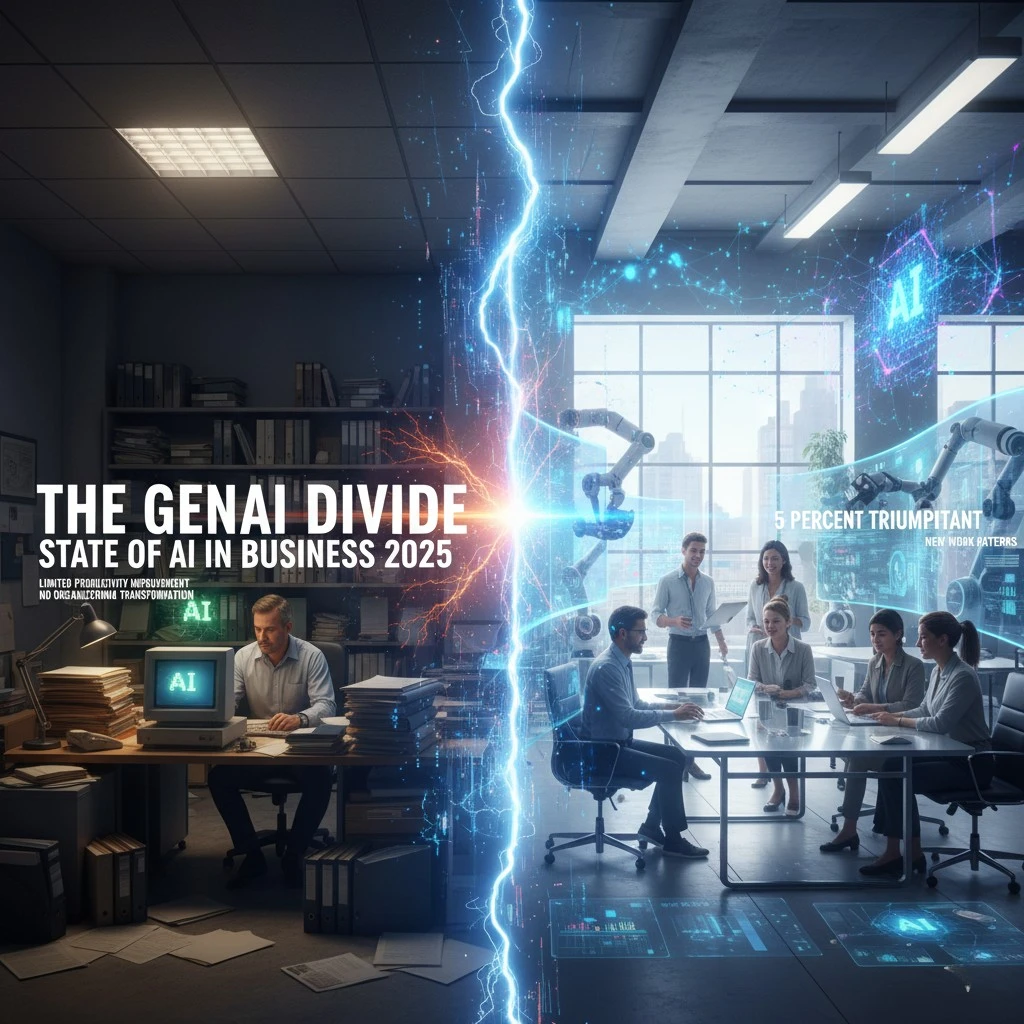
The GenAI Divide is the expanding divide between the companies adopting AI as a true change and those merely experimenting with it. According to the MIT report (which indicates a total of 300 reviews of enterprises and 200 replies from the executives), businesses are divided into two quite different camps.
The former involves small tasks that take AI. They receive limited productivity improvement alongside no organizational transformation.
The second category applies AI to remake the way work is done. They create systems that learn, evolve, and act throughout the workflows.
The few companies that have taken this leap are very few. They belong to the triumphant 5 percent.
The rift is increasing due to the fact that today, AI does not write prompts any longer. It is regarding the development of new work patterns.
Related: https://exrwebflow.com/artificial-intelligence-ai-solutions-company/
Key Findings from The GenAI Divide: State of AI in Business 2025
According to the MIT NANDA report, there is a wide divide between the rate at which enterprises are deploying AI and the insignificant change an enterprise is actually experiencing at scale. These revelations reveal the reason why the vast majority of organizations languish in experimentation, but few make any genuine transformations. Both insights bring out the increasing gap between AI applications and AI value.
95% of GenAI Pilots Fail to Reach Production
Most companies run pilots. They test tools. They try a small workflow. But nearly all these pilots slow down before they can get into actual operations.
- They are not attached to systems.
- They do not adapt to context.
- They fail to address compliance requirements.
- They do not fit in day-to-day work.
As a result, they never scale.
According to the MIT group, this is known as the pilot-to-production cliff.
Adoption Without Transformation
More than 80 percent of organizations already use ChatGPT or Microsoft Copilot. This increases the productivity of individuals but does not affect the way business is conducted.
Leaders do not look at results, but at actions.
The employees perceive that they are making progress, yet nothing changes the P and L.
Sector Disparities and Impact Gaps
Technology and media companies are the only ones that are transformed in reality.
Their products have already become information-based.
AI can write code.
AI can create content.
This implies that the value is direct.
The other industries require higher redesign to accommodate AI. That redesign is yet to occur.
Why 95% of AI Investments Fail: Inside the Enterprise Learning Gap?
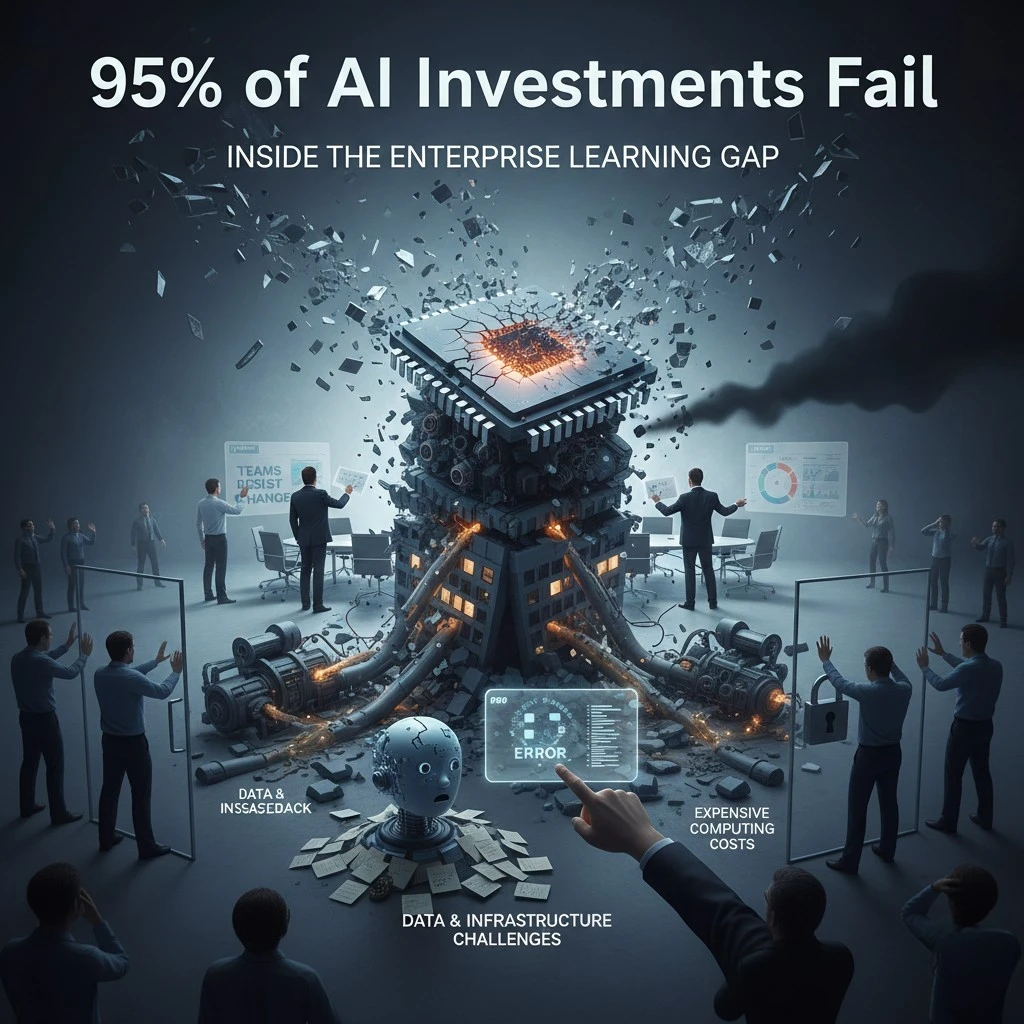
The majority of enterprise AI systems do not learn. They do not retain feedback. They are not flexible to changing workflow requirements.
This is the learning gap.
A non-learning system will be unsuccessful in a real business.
Data changes.
Requirements change.
People change.
Processes change.
It becomes useless to the user when AI is unable to adapt to users.
According to the MIT report, there are four primary causes of failure of AI within companies.
The Learning Gap
Enterprise tools are usually inflexible. They do not correct when corrected by the users. They are not able to store context between tasks. This renders them applicable in demos, but not in actual work.
Strategic and Leadership Failures
The vast majority of firms take AI as an IT upgrade.
They buy tools.
They create task forces.
They run pilots.
However, they are not redesigning the business around AI.
The absence of powerful C-suite leadership and a proper strategy keeps AI in the periphery.
Data and Infrastructure Challenges
Potential blockers become poor quality of data, disjointed systems, and expensive computing costs. The pipelines to run AI in production are not easily maintained, even in companies with good data.
Organizational and Cultural Inertia
- People fear losing control.
- Teams resist change.
- The departments are not cooperative.
- Lack of trust and training leads to adoption failure.
Start planning your transformation into GenAI in 2025.
Schedule a 30-minute Call!
The Shadow AI Economy: Where Real ROI Is Hiding?
The majority of companies are sure that their GenAI programs are not working. But behind the curtain, employees are daily using AI in such a way that it is providing actual, quantifiable productivity. This low-profile, bottom-up initiative is known as the Shadow AI Economy, and it is usually more developed than even the formal AI plan of the organization.
Bottom-Up AI Adoption
Employees are not awaiting leadership. They already rely on AI so that they can get the necessary work done in a shorter period.
Examples of typical shadow AI exercises are:
- Drafting emails
- Summarizing meetings
- Preparing documents
- Cleaning data
- Creating reports
- Troubleshooting questions
Why do they do this?
Shadow tools make interaction easy due to their flexibility, speed, and usefulness. Enterprise tools can be, in most cases, clunky and limiting.
C-Suite Perception vs Reality
The disconnect between leaders and what is happening and what actually happens is shocking.
Executives believe:
- Only a limited percentage of employees make use of AI.
- AI adoption is slow
- ROI is unclear
But employees report:
- About 90 percent use AI weekly
- Many make their own payments.
- AI can save already hours a week.
This incongruence is evidence that value is there, but the leadership is not able to perceive it since it is outside the framework.
Shadow AI as a Signal for High-Value Use Cases
Shadow AI does not present a danger to be done away with. It is a roadmap.
You can treat it as:
- Live heatmap of workflow pain points.
- Where automation will pay off.
- Verification of those tools that are liked by employees.
- A timely alert on where the existing systems are failing.
The business should invest where AI is being used secretly by the employees.
Shadow AI shows precisely where agentic workflows will be most effective.
Where the 5% Are Winning: High-Performing GenAI Implementations
A very few companies have passed the GenAI Divide. They don’t experiment with AI. They operationalize it. And they are playing out of the same playbook.
The following is a discussion of what the successful 5 percent do differently.
Common Traits of Successful Organizations
These have three main features in common:
1. Clear ownership
AI is led at the C-suite level. The initiative to push the roadmap is not IT-based only, but also the CEO or COO.
2. Business-first goals
No project starts with a model demo, but rather with a certain P&L outcome.
3. Cross-functional teams
In one team, they have domain experts, AI engineers, product managers, and operations.
This brings alignment, quickness, and responsibility.
Workflow Redesign and Deep Integration
The 5 percent rebuilds the process with AI in the middle instead of AI being added to the old processes.
What this looks like:
- AI draws information from numerous systems.
- AI generates first drafts
- AI updates records directly
- AI triggers next steps
- Exception monitoring is by humans.
Example workflow transformation:
| Step | Before AI | After AI |
| Document intake | Manual review | AI extracts and classifies instantly |
| Processing | Humans input data | AI pre-fills and routes data |
| Decisioning | Human-driven | AI prepares recommendations |
| Final output | Slow and inconsistent | Fast, standardized, supervised |
This is not “using AI.”
This is recreating work in such a way that AI comes into the engine.
Back-Office Automation Advantages
Large victories occur in the region of the greatest tension:
- Claims
- Compliance
- Invoicing
- Customer documentation
- HR operations
- Procurement
- Sales preparation
- Audit workflows
Why back-office leads:
- High volume
- Repetitive tasks
- Clear rules
- Heavy documentation
- Easy to measure
- Fast time-to-value
Even little improvements in the areas make big savings.
The results of the 5 percent are normally:
- 40 to 80 per cent decrease in cycle time.
- Multitasking saves thousands of hours annually.
- Millions of operational costs saved.
- Reduction of mistakes and escalations.
- Faster SLA fulfillment
These are the processes that take a firm across the GenAI Divide.
Hire AI Engineers to create flexible, self-dwelling systems to suit your processes.
From Chatbots to Agentic AI: The Next Phase of Enterprise GenAI
The majority of the firms do not go beyond chatbots. The 5 percent leaders have AI systems, which perform, apply, and enhance. This is the actual jump into change in the enterprise.
What Is Agentic AI?
Agentic AI systems can:
- Understand goals
- Break work into steps
- Use tools, APIs, and databases
- Work in cooperation with other agents.
- Learn from outcomes
- Operate inside workflows
A chatbot gives answers.
Work is done by an AI agent.
Emergence of Open Protocols (MCP, A2A, NANDA)
MCP
Trains AI in the proper usage and knowledge of software.
A2A
Enables agents to exchange, organize, and delegate tasks.
NANDA
Offers identity, faith, discovery, and incentives to agents.
These standards enable the Agentic Web.
Agentic AI Use Cases Across Industries
Insurance
- claims automation
- policy validation
Telecom
- sales preparation
- automated troubleshooting
Healthcare
- clinical documentation
- pre-authorization tasks
Finance
- KYC checks
- invoice processing
Logistics
- inventory updates
- supply chain coordination
An agentic AI adds value to any multi-step and rule-based work.
Why Small Language Models (SLMs) Are the Future of Enterprise AI?
SLMs have higher speed, are less expensive, and are easy to operate. They are much closer to the organized nature of enterprise workflows than the large general-purpose models.
SLMs vs LLMs
| Feature | LLMs | SLMs |
| Size | Extremely large | Under 30B parameters |
| Speed | Slower | Fast |
| Cost | High | Low |
| Hosting | Complex | Easy to self-host |
| Best Use | Creative tasks | Enterprise workflows |
SLMs act as specialists. The business requires experts.
Cost, Latency, and Scalability
SLMs offer
- Lower operating cost
- Faster response times
- Thousands of agents’ scalability.
- Easy private deployment
- Predictable workflow performance.
They eliminate the largest obstacles to AI implementation in the enterprise.
Heterogeneous Agent Architectures
The current AI systems are based on multiple specialized agents rather than one large model.
This includes
- One orchestrator model
- Many SLM agents of tasks.
- Invoking agents and tools, which make calls to APIs.
- A shared memory layer
- Exceptions are controlled by humans.
This system is more flexible, efficient, and less costly to maintain.
Crossing the GenAI Divide: 2025–2026 Enterprise Roadmap
The following 12-18 months will dictate who will be AI-native and who will be left behind. The current architecture decisions will determine the competitive advantage over the years.
The 12–18 Month Architecture Window
- This window is essential as it is crucial since
- Suppliers are capturing long-term purchasers.
- The development of architecture becomes firm.
- Interoperability has become a barrier to rebuilding later.
- Agentic systems need early planning of integration.
Selecting the improperly placed foundation slows the adoption of AI by years.
Strategic Playbook for CEOs, CTOs, and BU Leaders
For CEOs and Boards
- Develop a precise AI vision that is linked to business achievements.
- Represent AI as a business transformation.
- Sponsor workflow redesign
For CTOs and Heads of AI
- The change from single model systems to multi-agent systems.
- Create powerful data, MLOps, and memory tiers.
- Embrace open protocols such as MCP and A2A, and NANDA.
For Business Unit Leaders
- Strategy for business problems.
- Determine workloads with high amounts of friction.
- Drive adoption and training
Every leader is the driver of a different aspect of AI.
Identifying High-Value, High-Friction Workflows
The best workflows are characterized by the following features:
- many steps
- heavy documentation
- long cycle times
- high error rates
- many systems involved
- clear measurable outcomes
- compliance requirements
High-impact examples
- claims processing
- procurement operations
- vendor onboarding
- loan underwriting
- sales preparation
- audit workflows
- compliance checks
- case management
These processes bring quick and quantifiable ROI, automated by agentic AI.
EXRWebflow will assist you in creating high-performance, artificially intelligent readied experiences in the enterprise.
Measuring What Matters: Beyond Vanity Metrics
Companies are following most of the wrong things. Logins. Interactions. Chat volume. These vanity measures fail to indicate the assistance that AI is providing to the business. The 5 percent measure that is successful is the one that is linked directly to performance.
Business Outcomes
These measures indicate that AI has an effect on the bottom line.
- revenue growth
- cost reduction
- risk reduction
- cycle-time improvements
- profit margin impact
Unless AI can enhance these figures it is not providing enterprise value.
Operational KPIs
These are actual gains within working processes.
- process throughput
- error reduction
- time to resolution
- SLA adherence
- quality consistency
Turning the operations demonstrates the realization of AI in transforming work.
Adoption and Behavioral Metrics
Such measurements demonstrate the usage of the system by people.
- active usage
- frequency of use
- task completion rate
- escalation to human experts
- user satisfaction
When users have many and little growth, it is an indication of confidence and credibility.
From Shadow to Strategy: Governing the Shadow AI Economy
Shadow AI is not a threat. It is a clue. It demonstrates the places where the employees get the values well before the leadership realizes it. Companies ought to direct it and render it safe as opposed to blocking it.
Risks of Banning Shadow AI
Bans lead employees to unsound tools.
- slows innovation
- removes any focus on leadership on actual workflow.
- hides productivity gains
- produces a discrepancy between policy and reality.
There is no stopping the use of AI by blocking. It only makes it invisible.
Formalizing Bottom-Up Productivity Gains
Shadow AI reveals
- which activities are automated by employees.
- which workflows are painful
- which tools people prefer
- where the most significant value already is.
Leaders can trace shadow use in order to designate high-value use cases and move them into official and secure systems.
Governance and Guardrails
The administration does not imply control. It means structure.
- clear approved tools
- data safeguards
- access policies
- logging and monitoring
- and literacy and training programs.
The channels of governance bring viable energy to bottom-up implementation.
Suggested Read: https://exrwebflow.com/why-business-fails-with-ai/
Building AI-Native Organizations
Artificially intelligent firms reengineer the workplace. They view AI agents as co-workers, rather than equipment. They create systems, which integrate human assessment and robot powers.
North Star Vision
Leaders must define
- How is AI transforming the business model?
- Where will AI bring competitive advantage?
- What work processes should be reconstructed?
- How can the partnership between people and agents be created?
There is a clear North Star which leads architecture, hiring and investment.
Augmented Teams and MVOs
- Fully AI-based organizations will transform their functional teams into hybrid forms.
- AI is an essential aspect of the work of augmented teams.
- MVOs (Minimum Viable Organizations) presuppose small groups of people that supervise big groups of AI agents executing business processes as a whole.
Humans supervise. Agents execute. The result is speed and scale.
Process Data as a Competitive Moat
Data is produced with each activity of an agent.
- every correction
- every decision
- every exception
- Every completed task
This information turns into proprietary information that would educate later agents. In the long run, it turns into a moat that none of the competitors can replicate.
Get the help of experts and speed up your AI roadmap and cross the GenAI Divide with ease.
Contact Us!
Final Thoughts
One of the truths conveyed in the GenAI Divide: State of AI in Business 2025 is as follows: the distance between the companies that experiment with AI and those that redesign their workflows around it is closing rapidly. Any change is real when organizations start going beyond chatbots, adopt agentic systems, and transform shadow adoption into a formal capability. The 12 to 18 months ahead will define who will reach this divide and be actually AI-native, and who will be left behind in pilot mode, where competitors will be speeding ahead.