
Imagine that your doctor could be able to identify a disease long before you started having symptoms.
This is not science fiction anymore. It already takes place through AI in healthcare.
But here is the problem.
Although artificial intelligence in healthcare can allow making diagnoses faster, cheaper, and more successful, there are numerous healthcare organizations that find it difficult to leave pilot projects behind. Artificial intelligence sounds mighty and hard on paper, but hard in hospitals.
In this article, the authors deconstruct the current state of AI in healthcare, its difficulty to adopt, and the manner in which the sector can proceed responsibly.
What is AI in Healthcare?
AI in healthcare can be defined as computer systems that interpret medical data, learn patterns, and help humans to make more clinical and operational decisions.
AI does not substitute doctors, but it assists them.
The common types of artificial intelligence in the medical profession include systems that:
- Analyze medical images
- Predict disease risks
- Help with the treatment decisions.
- Automate administrative functions.
AI applications are taught on massive datasets of medical records, lab reports, and scans. As time goes on, they enhance accuracy and speed.
When Did AI Become Popular in Healthcare?
AI got into healthcare many decades ago in the form of rule-based expert systems. However, its actual adoption picked up pace after 2012.
This was made possible by three larger changes:
- Digitalization of health records.
- Growth of cloud computing
- Jobs that machine learning has broken through.
As per McKinsey, AI applications in healthcare would have the potential to generate up to 100 billion dollars per year of value within the healthcare system in the US.
Core AI Technologies in the Healthcare Industry
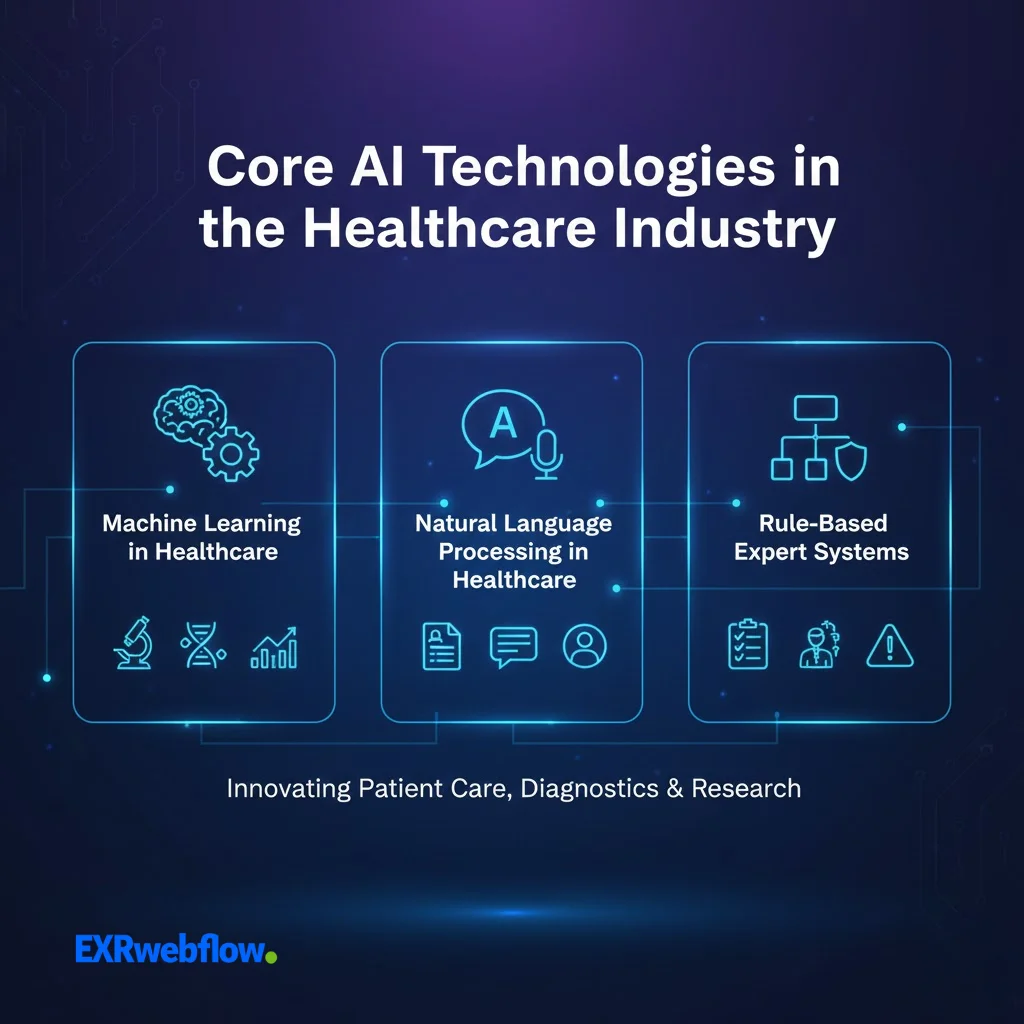
The application of artificial intelligence in healthcare is not a single tool. It is a blend of technologies that collaborate to assist physicians, hospitals, and healthcare systems. All the technologies address a problem that is different, yet they also lead to better decisions and patient care.
Machine learning, natural language processing, and rule-based expert systems are the most popular AI technologies that are utilized in the healthcare sector.
Machine Learning in Healthcare
Machine learning drives the majority of the current AI in healthcare.
It enables computer systems to learn through medical data and develop over the years, without manual programming. These systems are used to analyze trends in massive amounts of data from lab reports, medical images, and patient histories.
The application of machine learning in the artificial intelligence healthcare industry uses:
- Disease risk prediction
- Medical image analysis
- Outcome prediction during treatment.
- Personalized care planning
There is research published in The Lancet Digital Health which demonstrates that machine learning models can match or outperform clinicians in a number of diagnostic tasks, particularly in radiology and pathology. This renders machine learning as a pillar of artificial intelligence in the medical industry.
Natural Language Processing in Healthcare
Natural language processing, or NLP, aids the AI systems in interpreting the human language.
Healthcare is producing huge volumes of unstructured texts. Doctor notes, discharge reports, and clinical reports can not be analyzed at scale. NLP clocks out this issue by utilizing written language in data.
Application of NLP AI in healthcare facilitates:
- Computerized clinical documentation.
- Derivation of insights within the electronic health records.
- Bill and coding automation in medicine.
- Virtual assistants and patient-facing chatbots.
One of the studies conducted by the American Medical Association revealed that physicians used almost two hours of documentation as compared to one hour of patient care. Artificial intelligence powered by NLP in the medical field minimizes this load and enables the practitioner to spend time on patients rather than on paperwork.
Rule-Based Expert Systems
One of the earliest artificial intelligence applications in the healthcare sector was rule-based expert systems.
These systems are actuated on the basis of pre-determined medical principles developed by specialists. They are not learned in the same way as machine learning models, but end up being very transparent and predictable.
Systems based on rules are still applied in:
- Drug interaction alerts
- Clinical decision support tools.
- Triage protocols
- Compliance checks
Although less flexible, rule-based expert systems are still useful in structured settings where it is important to be able to explain the results. They remain as supporting agents in artificial intelligence healthcare solutions.
Interested in implementing AI in healthcare in your company? Our team provides you with professional advice depending on your objectives.
Schedule a 30-minute Call!
Why Does AI Matters in the Healthcare Industry?
The global healthcare systems are straining. The traditional approaches are no longer sustainable because of growing costs and shortages in the workforce and surging demand by patients. This is where AI in healthcare is critical.
AI is beneficial by assisting health facilities in providing quality care with reduced resources, improving the accuracy and efficiency of healthcare.
Importance of AI in Healthcare
The significance of AI in the healthcare sector is that it will be able to convert complex medical data into insights that can be translated into actions.
Artificial intelligence in healthcare assists by:
- Detecting diseases earlier
- Reducing diagnostic errors
- Enhancement of personalization of treatment.
- The optimization of the work of the hospital.
According to the World Economic Forum, AI-based healthcare applications may help enhance patient outcomes by up to 40 percent and cut the cost of treatment by a significant margin. This renders artificial intelligence in the medical industry a strategic requirement and not a luxury.
How AI Is Reshaping Clinical and Administrative Decision-Making
Artificial intelligence in the healthcare setting transforms decisions at all levels.
In the clinical front, AI helps physicians to analyze patient data, compare it to millions of other similar cases, and provide evidence-based recommendations. This facilitates quick and more educated medical judgments.
Our administrative aspect of AI application in healthcare is better:
- Scheduling efficiency
- Revenue cycle management
- Resource allocation
- Fraud detection
Artificial intelligence healthcare systems are decision support systems rather than human judgment substitution. They save mind bandwidth, reduce errors, and enable healthcare providers to give attention to matters that should count the most, i.e., patient care.
Use of AI in Healthcare Today
The application of AI in medical practice is not experimental anymore. Hospitals, clinics, and healthcare systems widely capitalize on artificial intelligence in healthcare to enhance the workflow and the quality of care provided.
Nowadays, AI facilitates medical choices, as well as the ordinary work routines of hospitals, and this technology is regarded as one of the most influential in the sphere of healthcare.
Diagnosis and Treatment Applications
Among the most prominent applications of AI in the medical field are diagnosis and therapy.
Intelligence assists in medicine to allow doctors to identify illnesses at an earlier stage and offer improved treatment options by evaluating a considerable amount of information about the patients.
Any typical diagnosis and treatment uses are:
- Cancer, fracture, and neurological cancer medical imaging examination.
- High-risk patient predictive models.
- Tailored claims of treatment relying upon history and genetics.
- Point-of-care clinical decision support systems that aid physicians.
According to the research conducted in Nature Medicine, AI systems are capable of detecting some cancers based on the imaging data with an accuracy rate equivalent to or even higher than that of the radiologists involved in the study. This shows how artificial intelligence healthcare tools contribute to human knowledge and expertise and do not eliminate it.
Administrative and Operational Applications
In the healthcare sector, AI is also essential in administration and operations in addition to clinical care.
Such applications save time and effort for labor and make healthcare organizations run better.
The major administrative and operational applications are:
- Calling appointments automatically.
- Medical billing and coding assistance.
- Benefit processing and fraud detection.
- Optimization of resources and personnel in the hospital.
A report by Accenture has stated that AI applications in the administrative system will save tens of billions of dollars each year for the healthcare system of the US. It is in this respect that the applicability of AI in healthcare makes the use of AI as essential to a healthcare institution as its clinical performance.
Implementing AI solutions in healthcare? Hire an AI engineer to transform the ideas into secure, compliant, and scalable systems.
Benefits of AI in Healthcare
The usefulness of AI in medicine covers patients, providers, and systems as a whole. Artificial intelligence use in healthcare provides better results at a reduced cost when used properly.
Clinical Benefits
AI has a direct effect on patient care, as it assists in making more precise medical decisions in a shorter amount of time.
The associated clinical advantages comprise:
- Early disease detection
- Relative high diagnostic accuracy.
- Reduced medical errors
- Plans of treatment that are more individual.
The Lancet study concluded that AI-assisted diagnosis is potentially applicable in helping to minimize misdiagnosis rates in complex conditions. This will affirm the increasing purpose of artificial intelligence in the field of medicine as a clinical support system.
System-Level and Operational Benefits
In a healthcare organization, AI can be used at the system level to make health institutions work more efficiently.
| Benefit | Impact on Healthcare Systems |
| Lower costs | Reduced unnecessary tests and procedures |
| Higher efficiency | Faster workflows and better resource use |
| Reduced burnout | Less administrative burden on clinicians |
| Scalability | Better care delivery on a larger scale |
These enhancements at the system level demonstrate why artificial intelligence healthcare applications are necessitating sustainable healthcare provision.
Recent Advances in Artificial Intelligence in Healthcare
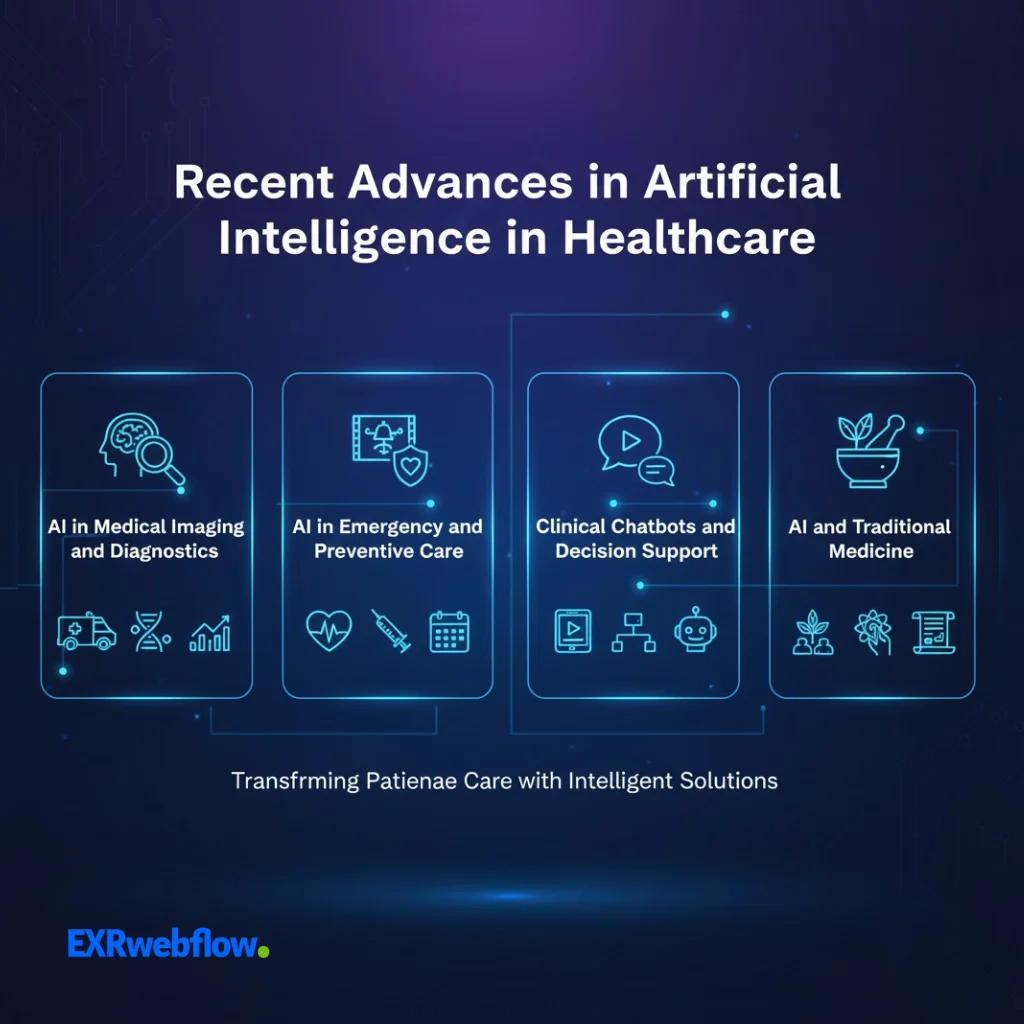
The field of artificial intelligence in healthcare is developing at a rapid rate. It is being utilized in real hospitals, ambulances, and clinics, which previously were considered experimental. These developments indicate the way AI in the healthcare sector is transitioning from an aid tool to a critical system.
AI in Medical Imaging and Diagnostics
One of the most robust sectors of AI in the medical industry is medical imaging.
X-rays, CT scans, pathology slides, and MRIs can be analyzed with high accuracy using artificial intelligence in the medical field. These AI systems identify patterns that cannot be easily identified by the human eye, particularly in the initial stages of the disease.
Recent advances include:
- Artificial intelligence models that identify breast cancer at an earlier stage as compared to conventional screening.
- Brain scan stroke identification tools in seconds.
- Fracture detection in emergency rooms is automatic.
In 2023, research published in Nature Medicine seemed to have established that AI diagnosing technology was as good as or better than human diagnostic skills in most imaging issues. This confirms the increasing credibility of artificial intelligence health care solutions in diagnosis.
AI in Emergency and Preventive Care
AI is also changing the ways in which healthcare systems react to emergencies and prevent diseases.
AI is important in emergency care, as it can predict patient inflow and prioritization. In prevention, it detects risk even before the symptoms manifest.
Applications of AI in caring in health care in emergency and preventive areas involve:
- Anticipating the overcrowding in the emergency room.
- The improvement of ambulance dispatch routes.
- Diagnosing the high-risk patient of heart disease or diabetes.
- Following health trends in the population.
The World Health Organization says that early intervention and prevention of avoidable hospitalization can benefit greatly thanks to AI-driven predictive tools.
Clinical Chatbots and Decision Support
One of the most conspicuous developments of artificial intelligence in healthcare is clinical chatbots.
Such AI-driven applications will help patients self-navigate through their symptoms, provide simple medical support questions, and follow up. In the case of clinicians, the AI decision support systems process the data related to patients and give evidence-based advice.
Common applications include:
Between 2004 and 2014, interviewees noted the appearance of symptom assessment chatbots.
- Medication reminders
- Post-treatment monitoring
- Physician clinical notification.
Research demonstrates that properly developed chatbots enhance engagement among patients without affecting safety. This renders them useful extensions of artificial intelligence healthcare systems.
AI and Traditional Medicine
AI is not something that replaces traditional medicine. It strengthens it.
Artificial intelligence in the healthcare sector supports the conventional methods of healthcare by offering accuracy and reliability. Physicians will continue to make end-of-reference decisions, but AI will give information according to the data.
This partnership assists it in integrating clinical experience and machine intelligence to formulate a balanced care approach.
Require a tailor-made AI-driven medical platform? One of the potential partners in the field of designing, developing, and launching intelligent digital solutions is EXRWebflow.
Strategic Roadmap for AI Success in Healthcare
To successfully implement AI, planning is necessary. The failure of many healthcare organizations is not related to the fact that AI is not working, but the implementation process is too hasty or poorly aligned.
An obvious roadmap will assist in transforming an experiment of artificial intelligence in healthcare into a durable system.
Phase 1: Strategic Foundation
The initial stage is the preparation stage.
Healthcare organizations are supposed to:
- Determine actual clinical/operative issues.
- Assure quality and safe information.
- Manage leadership, clinicians, and IT teams.
- Institute rules and codes of conduct.
AI projects cannot scale without this basis.
Phase 2: Early Wins and Validation
The second stage concerns the proving of value.
Key actions include:
- Initiating small pilot projects.
- Assessing clinical and operational outcomes.
- Engaging clinicians in the feedback loops.
- Perfecting models according to actual practice.
The initial success will create confidence in the use of artificial intelligence in healthcare and make people adopt it.
Phase 3: Scaling and Optimization
AI can be scaled throughout the company once proven.
This phase focuses on:
- AI implementation at work.
- Monitoring and improvement of models.
- Training and upskilling the workforce.
- Responsible AI application.
It is at this point that AI would have been integrated into the healthcare infrastructure as opposed to a tool.
Core Challenges of AI in Healthcare
Although innovation is fast, AI in healthcare has some severe challenges. Such obstacles decelerate usage and reduce the effect in practice. Knowledge of them is essential to the healthcare leaders, clinicians, as well as technology providers.
The use of artificial intelligence in health care is only possible when the system, technology, and people are in harmony.
AI Adoption Challenges in Healthcare at a Glance
The most prevalent problems of AI in the healthcare industry are:
- Lack of quality and fragmentation of data.
- Security and privacy issues.
- Distrust amongst clinicians.
- Workflow disruption
- Economic uncertainty regarding regulations and laws.
- The lack of AI-qualified medical workers.
Such issues are related to one another. It is not rare that solving one involves solving others.
Data, Privacy, and Trust Challenges
Artificial intelligence in healthcare is based on data. Even the most sophisticated AI models will not work without credible information.
Solving the Healthcare Data Puzzle
Healthcare information is dispersed over systems. Data may arise in separate places in hospitals, laboratories, radiology facilities, and insurance companies.
This kind of fragmentation does not benefit AI in healthcare since:
- There is a lack of complete patient records.
- The data formats are not consistent.
- The communication is not effective between systems.
Scalable solutions in artificial intelligence healthcare need interoperability and standardization of data.
The Hidden Dangers of Flawed Data
Machine learning is based on past experiences. In case there are flaws in the data or problems with accuracy, AI decisions will indicate such problems.
Articles released in Science found that discriminatory healthcare algorithms underutilized millions of patients with care requirements. This points to one of the greatest dangers of AI in healthcare.
Flawed data can lead to:
- Misdiagnosis
- Unequal treatment outcomes
- Loss of trust in AI systems
The quality and variety of data are crucial to artificial intelligence in the healthcare sector, which is safe and equitable.
Navigating the Privacy and Security Tightrope
Healthcare information is extremely delicate. Preservation of the privacy of patients is an ethical and legal matter.
HIPAA and GDPR are among the key regulations that artificial intelligence in healthcare should adhere to. Meanwhile, AI-run entities are being exposed to more cyberattacks.
Some of the main privacy issues and security issues are:
- Data breaches
- Unauthorized access
- Consent management
- Secure data sharing
One of the most challenging issues in the AI in healthcare industry is balancing between innovation and privacy protection.
The Black Box Problem and Building Trust
A great number of AI models are black-box models. They give answers but fail to elaborate on the process of making choices.
This is detrimental to transparency, which causes reluctance among clinicians.
Doctors want to understand:
- Reasons why an AI system was used to give a recommendation.
- What data did the decision take into consideration?
- How reliable is the output?
AI can be explainable in order to fill this gap. There is increased trust when artificial intelligence healthcare systems work with rather than against clinical judgment.
From Pilot to Practice: Implementation Barriers
A lot of AI initiatives work well in controlled pilots but fail when implemented in the real world. One of the key problems of AI in healthcare is the distance between testing and practice.
Workflow Integration Challenges
There are complicated healthcare processes. AI tools are not always effective because they have to introduce new steps rather than make work easier.
Typical issues in workflow are:
- Alert fatigue
- Poor system usability
- Breakage of clinical practices.
Effective artificial intelligence in healthcare does not require change; instead, it becomes a part of the current operation.
Cultural Resistance and Clinician Concerns
The use of technology is not merely technical. It is human.
Clinicians may worry about:
- Loss of autonomy
- Increased liability
- Job displacement
Such anxieties impede the implementation of AI in healthcare. The keys to overcoming resistance are open communication and involvement of clinicians.
Closing the AI Skills Gap
Several medical workers are untrained on AI systems. Even effective tools are not used properly without proper education.
To narrow the skills gap, it is necessary to:
- Clinician AI literacy training.
- Cross-functional collaboration
- Constant training and encouragement.
Artificial intelligence healthcare projects require long-term success, which is possible only through the upskilling of the workforce.
Regulatory, Ethical, and Legal Landscape
The regulation determines the development of AI in healthcare. It secures patients and directs conscientious innovation.
Global Regulation of AI in Healthcare
The regulations of AI vary in different regions. The greatest majority of frameworks are concerned with safety, openness, and responsibility, however.
The systems of AI used in healthcare organizations need to be tied to legal and medical standards.
EU Legislation Shaping AI in Healthcare
The European Union is at the forefront of regulating artificial intelligence in health care all over the world.
Key regulations include:
The AI Act
The healthcare AI systems are designated as high-risk by the AI Act.
It requires:
- Risk assessments
- Transparency
- Human oversight
This makes AI usage in the healthcare industry safe.
European Health Data Space Regulation (EHDS)
EHDS is meant to enhance the sharing of data in Europe, as well as safeguarding privacy.
It promotes innovation and enhances patient rights.
Product Liability Directive
This regulation revises the liability laws of AI products.
It explains liability in cases of artificial intelligence healthcare systems.
A combination of these regulations establishes a representation of attainable safety, ethical, and responsible AI in the field of medicine.
Real-World AI Use Case Challenges
Practical implementation demonstrates an aspect of AI in medical care that is not reflected in the lab tests. Although artificial intelligence in healthcare works very well in controlled settings, real-life clinical scenarios provide complexity, inconsistent systems, and human behavior. These examples of cases underline the potential value provided by AI use in healthcare and also reveal external real-life issues that organizations should manage.
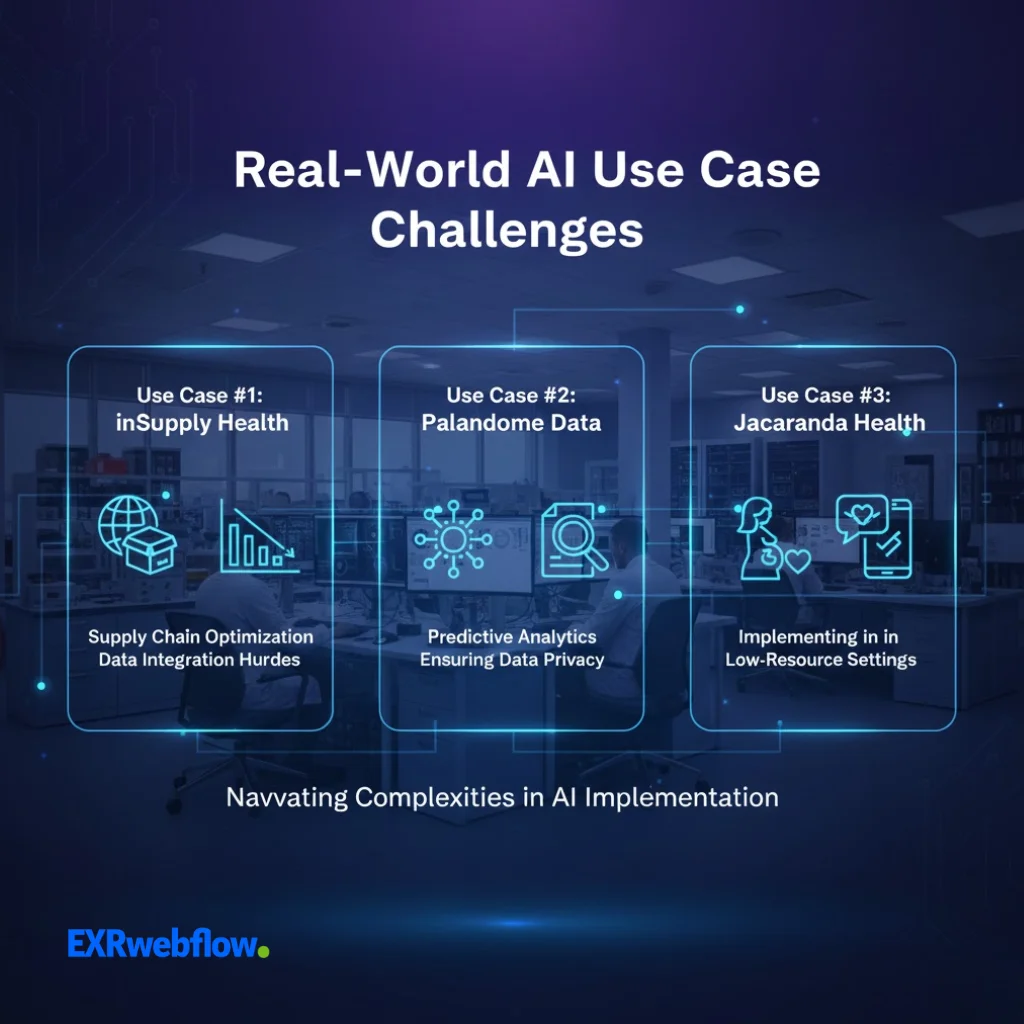
Use Case #1: inSupply Health
InSupply Health was an application of artificial intelligence, used in the healthcare sector to enhance the prediction of medical supplies and minimize shortages. The AI system evaluated past purchasing data, seasonal variation, and hospital usage patterns. Although the model had a strong predictive accuracy, when the implementation commenced, there were significant integration difficulties. Information was spread across different systems, and inconsistent reporting inhibited real-time insights. The case has shown that artificial intelligence in healthcare requires more data infrastructure than algorithms.
Use Case #2: Palindrome Data
Palindrome Data is an artificial intelligence company that applies the technology in healthcare to automate clinical chart abstraction. With the help of machine learning and natural language, the platform extracts the structured information from unstructured medical records. The initial findings were efficiency improvement, and the time spent on manual review was decreased. Nonetheless, accuracy was hard to achieve when using various clinical documentation styles. The point was that artificial intelligence in the medical sphere should be applied as an augmentation tool and not as an automation one, as it is important to be under constant human supervision.
Use Case #3: Jacaranda Health
Jacaranda Health tried to implement AI-driven decision support tools to enhance maternal health outcomes in low-resource settings. The protocol entailed clinical advice generated by the system according to the symptoms of the patients and the protocols. Although the effect on quality of care was high, the expansion of the solution caused problems in terms of connectivity, training, and localization. The given use case demonstrates the way in which artificial intelligence-based healthcare applications should adjust to local realities to gain sustainable results.
The Future of AI in Healthcare
The AI in healthcare is not about doctor replacement in the future. It is all about empowering the healthcare system by making it smarter, quicker, and more customized. With the maturity of artificial intelligence in the field of medicine, responsible innovation, transparency, and human cooperation will be the key to success.
Emerging Trends and What to Watch Next
Recent developments in AI in healthcare are more complex and predictive systems. Developments in multimodal AI complexity enable models to process text, images, and data on the patient in tandem. Faster clinical decisions are being made possible through real-time analytics, and privacy is being enhanced with the help of federated learning because the data remains decentralized. These tendencies bode well for the move towards more scalable and reliable artificial intelligence in the healthcare sector.
Next-Generation EHRs and Intelligent Automation
The next stage of electronic health records will no longer be data storage. Future EHRs, with the help of artificial intelligence in healthcare, will be able to predict the needs of clinicians, do routine tasks automatically, and reveal pertinent information directly in the care unit. Smart automation will help in lessening administrative load and enable medical workers to spend more time addressing patients and making clinical decisions.
Transforming the Future of Medicine
The medical field is transforming medicine, moving away from the reactive paradigm towards the preventive paradigm through artificial intelligence. The personalized treatment, predictive analytics, and constant monitoring will transform care delivery. Directly paired with medical expertise and moral governance, AI in health care could make health care systems around the world safer, more efficient, and more even.
Need to change the healthcare sector using AI? Implement the first step to smarter, data-driven care.
Let’s Begin!
Conclusion
AI in healthcare is an idea that is no longer in a future. It is already influencing the manner of care delivery, management, and its enhancement. Artificial intelligence in healthcare can be used in practice in diagnostics, operations, and other fields; that is, artificial intelligence is really worth it under the condition of a proper data set, a well-defined plan, and human management. The winning organizations will be the ones that will consider AI as a helping tool to clinicians rather than their substitution and invest the same amount of money in trust, ethics, and abilities as in technology.
Frequently Asked Questions (FAQs)
What Is the Biggest Challenge to AI Adoption in Healthcare?
The largest obstacle is the quality of data, along with credibility. The accuracy and unhelpfulness of data are needed by AI systems, and clinicians should be confident in the outputs until they apply AI systems to actual medical decisions.
How Can Healthcare Organizations Build Trust in AI?
Transparency, explainable models, and involvement of the clinicians help in building trust. When physicians know how AI can be used to aid their choices, they will adopt it
Is AI Cost a Barrier for Smaller Healthcare Providers?
The cost may serve as an obstacle, yet in healthcare, artificial intelligence is becoming more affordable to smaller providers with cloud-based and modular AI.
How Is Artificial Intelligence Transforming the Medical Field?
The use of artificial intelligence in the health sector raises the quality of diagnoses, reduces the amount of administrative tasks, and increases the amount of more personalized and proactive treatment.