
Struggling with downtime, inefficiencies, and quality issues in manufacturing? Traditional automation can’t adapt to changing conditions, leaving factories prone to costly errors. Enter AI in industrial automation; machines that learn from data, predict failures, and optimize workflows in real time.
Incorporate AI into factory automation, robots that analyze information, anticipate failures, and optimize processes in real time. Automation in industries has been a necessity since the era of manufacturing, and it has enhanced the speed and consistency of the production process through the use of programmed machines and control systems.
However, traditional systems are constrained by the fact that they are predefined systems and are not adaptable. The advent of AI-driven industrial automation is changing the way factories and production plants work.
What Is AI in Industrial Automation?
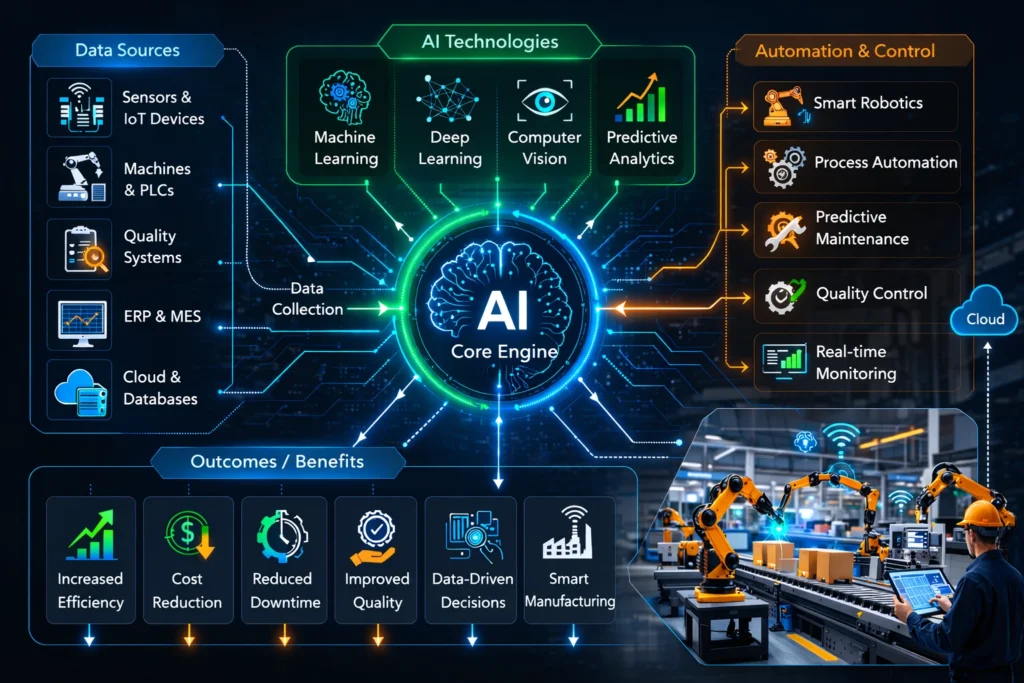
AI in Industrial Automation can be defined as the application of AI to industrial systems to enhance operational efficiency and decision-making through the adoption of machine learning, robotics, computer vision, and other AI technologies.
Standard automation is concerned with the implementation of a set of commands. Conversely, automation of industries using AI enables machines to learn and keep on enhancing their performance.
The main features of automation of manufacturing with the help of AI are:
- Data-driven decision making
- Self-education manufacturing systems
- On-site monitoring of the operations
- Smart process optimization
As an illustration, AI systems are able to analyze thousands of variables in production simultaneously to determine areas of inefficiency and suggest ways of improvement.
Why AI for Industrial Automation Is Becoming Essential
The current manufacturing space produces a huge volume of data produced by machines, sensors and production systems. This data is not utilized much without intelligent systems.
AI can eliminate this issue since raw data is converted into actionable insights.
Essential motives why industries are implementing AI automation in manufacturing industry.
- Better operational efficiency: Artificial intelligence examines the data of production to find the bottlenecks and streamlines the work processes.
- Higher product quality: The quality control systems are AI powered and have the capability to detect defects with more precision than manual inspection.
- Reduced downtime: Predictive analytics can be used to avoid unforeseen machine failures.
- Cost optimization: AI enhances the better use of resources and minimizes waste.
- Faster decision-making: Industrial data analytics enable managers to react promptly to production challenges in real-time.
Key Technologies Driving AI-Powered Industrial Automation
Many developed technologies allow AI-powered industrial systems.
1. Machine Learning in Manufacturing
Machine learning enables systems to be trained on historical production data and perform better with time.
Applications include:
- Anticipating machine failures
- Optimizing the production scheduling
- Identifying equipment anomalies
Machine learning algorithms process massive amounts of data to discover trends that are not easily discernible by human beings.
2. AI-Powered Robotics
One of the most apparent uses of AI in manufacturing is AI-powered robotics.
In contrast to the old-fashioned robots that use a pre-determined code, AI-enhanced robots can:
- Adapt to new tasks
- Work harmoniously with people
- Learn from operational data
Cobots are collaborative robots that are becoming more popular in assembly, packaging, and processing of materials.
Suggested: How Computer Vision Improves Operational Efficiency in Enterprise and Government AI Systems
3. Industrial IoT and AI
Industrial IoT and AI are forming a very strong ecosystem with machines constantly generating data on connected sensors.
Some of the examples of data gathered are:
- The levels of temperature and pressure
- Machine vibrations
- Production speed
- Energy consumption
AI systems use this information to enhance the efficiency of operations and minimize inefficiencies.
4. Computer Vision for Quality Control
The AI-based vision systems are cameras and deep learning algorithms that check on products in the production process.
Benefits include:
- Quickened inspection times.
- Higher detection accuracy
- Reduced human error
Computer vision is also extensively applied in the industries that demand high accuracy, like the electronics and automobile manufacturing sectors.
Major Benefits of AI in Industrial Automation
Knowing the value of AI in the automation of industries is valuable in enabling businesses to assess the effects of AI on the manufacturing processes.
Key benefits include:
- Improved efficiency in production
- Improved product quality
- Reduced maintenance costs
- Faster problem detection
- Improved use of resources
Research indicates that AI-based predictive maintenance can cut down on machine downtimes by half.
Predictive Maintenance Using AI
Prevention of failures in equipment before they happen is one of the most significant areas of AI-powered predictive maintenance in factories.
The maintenance traditional approaches are based on predetermined schedules. Such a strategy usually creates unnecessary service and sudden equipment failure.
Predictive maintenance involving AI is different.
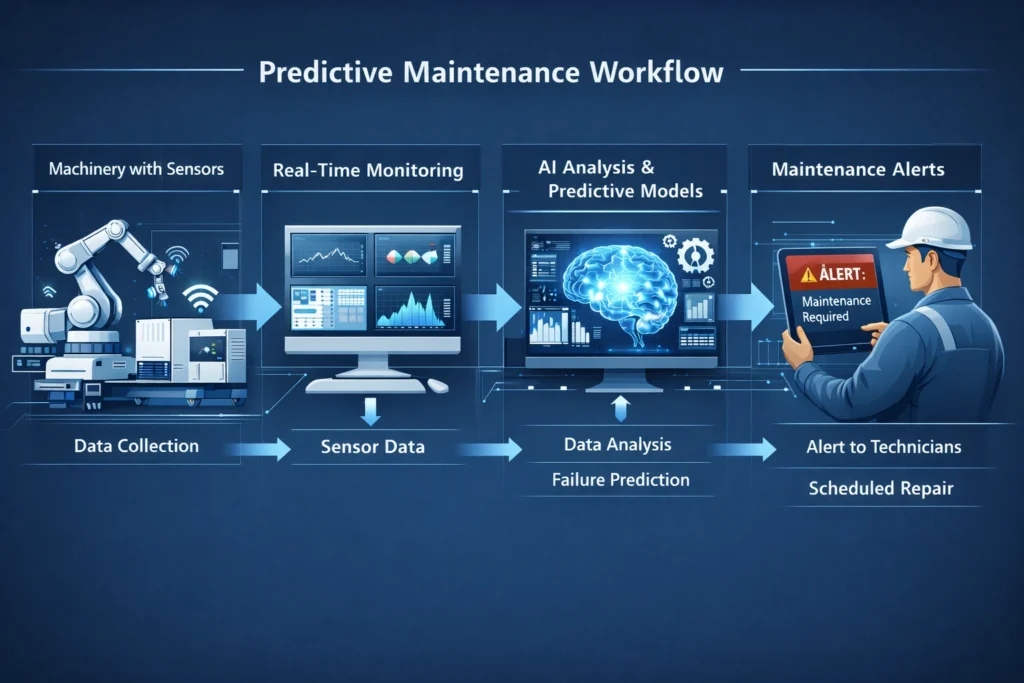
How predictive maintenance using AI works
- Real-time data on machines is collected by sensors.
- AI applications are vibration, temperature, and working pattern analyzers.
- The system identifies exceptions or precursors of breakdowns.
- Maintenance teams are alerted in time before equipment fails.
Advantages of predictive maintenance
- Reduced equipment downtime
- Lower maintenance costs
- Extended machine lifespan
- Better working stability
Predictive maintenance can save millions of dollars in downtime costs for manufacturers who have 24/7 production lines.
Real-Time Monitoring and Industrial Data Analytics
The use of industrial data analytics in modern factories helps to enhance operational efficiency.
The systems based on AI-monitors can give real-time data on machine performance and production indicators.
Smart factories have analyzed data that includes the following examples.
- Efficiency of the equipment
- Production cycle times
- Patterns of energy consumption
- Product defect rates
This is constantly analyzed by AI to determine inefficiency and suggest ways to improve it.
To illustrate, when a machine does not work at the ideal performance levels, the system is able to notify operators immediately and recommend some correction measures.
Real World Examples of AI in Manufacturing
The practical usefulness of intelligent automation can be discussed through the awareness of the real-world examples of AI in the manufacturing sphere.
Automotive Industry
Automotive companies cannot do without AI and robotics in the production process.
Applications include:
- Robotic welding and painting machines
- Artificial intelligence in quality control
- Material handling robots are autonomous in nature
Large car manufacturers take advantage of AI to streamline assembly lines and minimize factory flaws.
Electronics Manufacturing
Electronics production needs a great deal of accuracy.
AI systems help by:
- Inspection of flaws in circuit boards on a microscopic level
- Checking the accuracy of assemblies
- Maximizing production output
Computer vision is important in the process of ensuring the quality of products.
Oil and Gas Industry
The oil and gas industry is another area where AI is used to monitor important infrastructure.
Applications include:
- Monitoring systems in pipelines
- Drilling equipment predictive maintenance
- AI-driven safety monitoring
These systems minimize the risks of running the operations and enhance safety.
Food and Beverage Manufacturing
AI is applied in food processing companies to ensure quality and compliance.
Examples include:
- Automatically detecting the contamination
- Smart package technologies
- Smart supply chain optimization
Empower Exrwebflow’s AI in Manufacturing to optimize operations, boost productivity, and transform data into actionable insights for a competitive advantage.
AI and Industry 4.0: The Rise of Smart Manufacturing
Industry 4.0 is strongly connected to the notion of smart manufacturing.
Industry 4.0 is defined as the digitalization of manufacturing by means of the following technologies:
- Artificial intelligence
- Industrial IoT
- Cloud computing
- Advanced robotics
Under AI automation in the manufacturing industry, machines have networks where they interact and exchange data on their operations.
Characteristics of smart factories
- Self-operating production systems.
- Data-based decision-making in real time.
- Optimizing production lines by themselves.
- The digitization of the supply chains.
These functions enable the manufacturers to enhance their productivity and remain competitive.
According to the World Economic Forum, technologies driving Industry 4.0, including AI and IIoT, are reshaping the future of manufacturing by making factories smarter, more connected, and more efficient
AI-Driven Supply Chain Optimization
AI is also essential in enhancing supply chain management.
Manufacturers can optimize their supply chain through AI and thereby have improved inventory, demand, and logistics management.
Essential supply chain enhancements brought by AI
- Proper demand forecasting
- Automated inventory control
- Better logistics planning
- Less supply chain disruptions
The AI systems will examine previous sales records and market trends in order to predict the future and demand better.
Challenges of AI in Industrial Automation
As much as AI has its benefits, there are a number of challenges in implementing AI in industrial automation.
High implementation costs
The AI technologies are costly in terms of infrastructure and experience.
Data quality issues
In order to make accurate predictions, AI models require quality data.
Connectivity with legacy systems
A lot of factories still operate low-technology devices, which do not readily correspond with AI technology.
Workforce skill gaps
Training is required to train employees to work and maintain AI-powered systems.
Cybersecurity risks
Greater interconnection of smart factories can pose possible security risks.
These issues can only be overcome with proper planning and a long-term investment.
Future of AI in Industrial Automation
It is projected that the future of AI in industrial automation will introduce more sophisticated features.
Emerging trends include:
- Self-managed production systems that are able to operate complete manufacturing processes.
- Edge AI systems, which process data on the industry device to make decisions faster.
- Generative AI programs to assist engineers in creating more efficient products and manufacturing.
- Digital twins are simulating industrial processes to trial changes in advance.
Industry reports suggest that the artificial intelligence manufacturing market will expand rapidly in the next decade, as a greater number of companies will implement intelligent automation technologies.
How AI Improves Industrial Automation
In summary of the way in which AI enhances automation in industries, it can be seen that its effects are felt in various fields of operation.
Key improvements
- Machine learning for smarter machine operations.
- Quick defect detection with AI-based quality control.
- Predictive maintenance for reduced downtime.
- AI-driven analytics in optimized supply chains.
- More agile manufacturing with intelligent robotics.
These are the additions that make companies more efficient and competitive in the global markets.
Discover how Generative A Ican transform your business. Schedule a 30-minute call with Exrwebflow to explore affordable AI solutions and actionable strategies tailored to your objectives.
Wrapping Up
AI is essentially redefining the ways in which industries are going to automate. With artificial intelligence and better manufacturing technologies, the companies are able to design more efficient, intelligent, and flexible production systems.
Since AI-powered robotics and AI-supported predictive maintenance are possibilities, as well as industrial data analytics, and autonomous production systems, the uses of AI in industries keep growing.
Despite the fact that there are still challenges like the complexity of integration and data management, AI-powered industrial automation has great benefits. Present-day investment in AI-based automation will enable organizations to become leaders of the new smart manufacturing.
With the further development of technology, the importance of AI in industrial automation will become even more central in industrial innovation and competitiveness in the global market.