By 2026, software development as custom code will cease to be an IT decision but will become a growth decision for business. U.S. enterprises will spend more than 300 billion on software during each year, which they will mainly use to purchase custom software solutions.
Why? More than 70 percent of companies state that their business needs have outgrown the capabilities of standard software products. Organizations need to develop systems that match their operational processes and security measures and strategic objectives because of rising competitive pressure and customer demand.
Custom software development provides businesses with the freedom to develop more quickly, implement AI more smartly, and expand without restraint, making technology not a cost center but a growth engine.
What is Custom Software Development?
Custom software development is the practice of developing, developing and maintaining software customized to meet the individual requirements of a business or organization. Custom solutions are developed to meet specific workflows, industry regulations, and operational requirements as opposed to the off-the-shelf product.
They fit very well with your processes, enhance efficiency, and can be easily integrated with the existing systems, and even as your company grows.
The capability of custom solutions has also been enhanced with AI, cloud, and automation, which can include features not easily achievable with generic software, like predictive analytics, custom dashboards, and easy API integration.
Most firms have been employing tailor-made software in 2026 to further speed up the digital change, augment user experience, and outrun the competition.
Custom vs Off-the-Shelf Software
Business‑Specific Fit
- Custom Software:
Developed to fit your processes, workflows, and objectives.
- Off-the-Shelf:
This is designed to appeal to a wide audience, so it may not be just right for your needs.
Scalability
- Custom Software:
Scales with your business; it is easy to add new features and new users without significant challenges.
- Off-the-Shelf:
It is frequently restricted by updates from the vendors or license restrictions, and it is difficult to scale unless it is done through workarounds.
Cost
- Custom Software:
More costly in the short-term, yet greater ROI in the long-term due to removal of inefficiencies and payment of license fees.
- Off-the-Shelf:
It will be cheaper at first, but there are long-term expenses that can increase with add-ons, restrictions, or subscriptions.
Support and Maintenance
- Custom Software:
Complete control over updates and special attention from your development team.
- Off-the-Shelf:
This is also dependent on the schedule of the vendor; it may delay updates and corrections.
Flexibility
- Custom Software:
You are able to introduce new capabilities as your business progresses.
- Off the Shelf:
The features are pre-defined; the customization is not much, and it can be more expensive to adjust.
Are you prepared to see the impact custom AI could make on your business processes? We will be glad to create your next smart system together.
Why Custom Software Development Matters in 2026
Digital Acceleration of 2.9 Trillion
- The American technology market has a potential of 2.9 trillion with a growth rate of 8.3 percent per year.
- Custom software eliminates the recurrent SaaS charges and offers a greater ROI.
AI-Ready Architectures
- Agents Custom solutions can be used to incorporate Agentic AI, which can be used in autonomous workflows such as self-healing DevOps or AI-enhanced customer service.
- Trains businesses on AI-led B2B discovery, where 40 percent of the interactions are handled by autonomous agents.
Dealing with a Dearth of Developers
In the U.S., AI-assisted coding tools have a 1.2 million developer deficit and can be used to speed up and still deliver quality code.
Competitive Moats that are Industry-Specific
Healthcare: Telemedicine solutions with 500k+ patients per year, and that are in full compliance with 2026 rules.
Fintech: AI-based fraud detection systems with 1M+ transactions per day processing are up to 30-50 times more successful than generic APIs.
Types of Custom Software Solutions
Custom Enterprise Software Development
This is structured to fulfill the special operational requirements of giant organizations and to facilitate complicated working processes, inter-department cooperation, and sophisticated data handling. They are ERP systems, CRM systems, and supply chain management software.
SaaS Product Development
Software is provided through the cloud to various customers on a subscription basis. It is scalable and can be maintained with ease, enabling businesses to provide online services. It can be collaboration tools, project management tools, and marketing automation software.
Web Application Development
Web-based interactive applications that can be used without installation. These have the ability to process data in real time, customer portal and e-commerce solutions. They can be online banking systems, booking systems, and e-learning portals.
Mobile Application Development
Mobile applications that are dedicated to mobile devices, including iOS and Android, to improve customer interaction and offer mobile device services. They can be retail apps, food delivery apps and healthcare apps.
Cloud-Native Applications
Applications created to completely operate in the cloud via microservices, containers, and APIs. They provide high level of scalability, flexibility and cost effective infrastructure. Some of them are cloud-based analytics services, SaaS platforms, and IoT applications.
API and System Integration Solutions
These solutions provide inter-relationship between the various software systems so that there is smooth flow of data, interoperability, less manual work and enhanced efficiency of operations. These can be payment gateways, ERP integrations, and third party service connectors.
Suggested: https://exrwebflow.com/custom-ai-development-vs-off-the-shelf/
Custom Software Development Process (Step-by-Step)
1. Discovery and Business Analysis
This is done by first knowing your business objectives, target market, and areas of operation. This stage will entail interviews with the stakeholders, workflow analysis as well as competitive research to make the software solution fit flawlessly with your strategic goals.
2. Requirements and Technical Planning
Detailed functional and technical requirements are defined after its discovery. These encompass specifying features, integrations, data flow and system architecture. There is a well defined road map that is used to develop, approximate cost and realistic schedules.
3. UX/UI Design and Architecture
Designers create user experiences and user interfaces that are easy to use and user-friendly. Meanwhile, software architects establish scalable systems architecture, which includes technologies, frameworks, and cloud strategies to guarantee the performance, security, and further development.
4. Agile Development
The development follows an iterative form of sprint development, which enables constant feedback, testing, and adjustments. An agile approach will help deliver usable features faster, be flexible to any changes, and be business-focused.
5. QA and Security Testing
Quality assurance determines the reliability of the software, its functionality, and its bugs. Security testing determines vulnerabilities, deploys standards of conformity, and secures additional information against breach or attack.
6. Cloud Deployment
Depending on the architecture, the solution is implemented on clouds or on-premises servers. Deployment will involve installation of servers, databases, APIs and providing ease in integrating with existing systems.
7. Continued Maintainability and Optimization
The software is also constantly checked in terms of performance, updates, and possible enhancements, after the launch. This guarantees scalability, new business requirements, and maintenance of the system as being secure and efficient.
Custom Software Development Methodologies in 2026
Agile Development
Agile is an iterative approach, which provides the software on a short, incremental sprint. It also focuses on teamwork, fast feedback, and flexibility, enabling companies to realign the needs in a short period of time and have the software changed as needs change.
Hybrid Models
Hybrid models are based on Agile flexibility to be mixed with structured planning of Waterfall. These are applicable in projects in which documentation is required and timelines are predictable in certain parts and which sustain iterative and adaptive development in others.
DevOps and CI/CD
DevOps brings together operations and development in order to simplify software delivery. Continuous Integration (CI) and Continuous Deployment (CD will automate the testing and deployment process, minimize errors, enhance reliability, and shorten the release process.
When Waterfall Still Makes Sense
Waterfall is a chronological process because the next phase follows the completion of the previous phases. It can be used in a project where the requirements are set, few changes are expected, or complete compliance is necessary, e.g., in healthcare, finance, or aerospace.
We, at EXRWebflow, create Intelligent Software Solutions that combine the power of automation, data, and AI innovation according to the specific needs of your business.
Benefits of Custom Software Development
The key advantages of custom software development are as follows:
Designed to Suit Your Company Processes, Workflows, and Objectives: Unlike the standard off-the-shelf solutions, custom software is created to meet your business objectives, processes, and workflows.
Scalability: It is able to expand with your business and implement new features, users, or integrations without affecting the systems that are already in place.
Competitive Advantage: Your custom solutions can have one or more of the following features: unique features, automation, or AI tools that your business does not have.
Further Integration: Custom software communicates well with your current systems, databases, and third-party systems, enhancing efficiency in business.
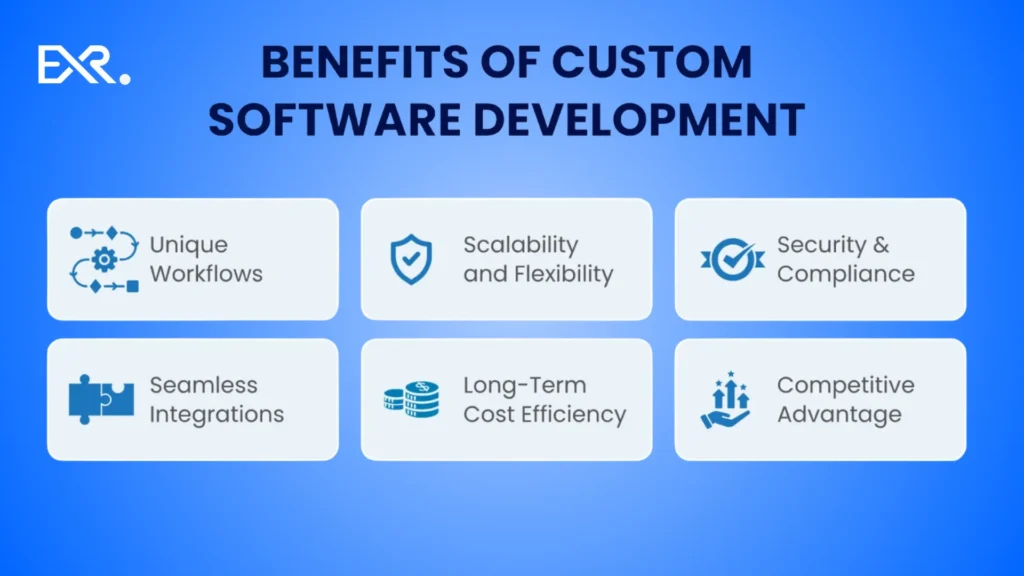
Increased Security: Custom software will have a higher level of security since it is developed based on the needs of your organization, and thus, the breach will be minimal.
Long-Term Cost-effectiveness: Although it demands a higher upfront cost, custom software saves recurring license payments, features not needed, and inefficiencies in the long run.
Better User Experience: Contexts and usages can be fostered to be more productive, and customer-liked among your team or customers.
Regulatory Compliance: Industry-specific regulations like HIPAA, PCI-DSS, or CCPA are capable of being fulfilled with custom software and mitigate the risk of compliance.
Flexibility to Future Innovation: Modular architecture will enable easier incorporation of new technologies into the future, such as AI, analytics or IoT.
Total Ownership and Control: You can do any updates, features and maintenance without relying on external vendors.
Custom Software Development Cost
Custom software development is a huge investment, which differs based on the size, complexity, and the skills needed. This is because by knowing these costs in advance, the businesses anticipate costs and are able to plan budgets, choose the right development partner and to prevent some unknown costs.
Cost by Project Size
Small Projects: They are in the range of $30,000 to $80,000, which are appropriate to MVPs, basic web or mobile apps, or internal automation tools.
Mid-Sized Projects: These are between $80,000 and $250,000 and can be characterized as a multiplicity of integrations, sophisticated functionality and moderate customization.
Enterprise Projects: Up to and over $250,000, is intended to be used in large organizations with complicated workflows, multi-department integration, high security, and scalability needs.
US Hourly Rates vs Offshore Comparison
US-Based Developers: $100 -250 per hour based on experience and specialization.
Offshore Developers: 25-75/hour, which can save the cost but will need close control of the project in order to preserve quality and schedules.
Factors Affecting Pricing
- Complexity and scope of the project.
- Platforms (count Web, mobile, cloud)
- Security and compliance requirements (HIPAA, PCI, CCPA).
- Support in terms of integration with existing systems and APIs.
- Design and UX requirements.
Hidden Costs to Consider
- Constant services and updates.
- Third-party tools are licensable.
- Cloud hosting/server expenses.
- Training for internal teams.
- Unexpected scope changes.
Common Challenges in Custom Software Projects
Scope Creep
Scope creep is the addition of new features or changes that are not intended to be added to the original project plan and they usually lead to project delays and hindered costs.
Solution: Clarify the project requirements at the beginning, employ a change management practice and rank features with a product backlog or roadmap.
Budget Overruns
Projects can go over-budget because of complexity that is under-estimated, technical difficulties or added features.
Resolution: Have real budgets, have contingency funds and regularly check on expenses through open reporting.
Communication Gaps
Poor congruence among the stakeholders, the developers, and the project managers may result in miscommunication and deadline failure.
Solution: Regulatory meetings, collaborative project management tools, and documentation should be well up-to-date to enable the alignment of everyone.
Technical Debt
Technical debt can be generated by short cuts made in the development process or ageing technology decisions, which increases the speed and expense of updating the system in the future.
Resolution: Adhere to the best coding practices, review code and schedule the refactoring and updating of systems.
Vendor Lock-In
The overdependence on the tools, platforms, or proprietary technologies of a single vendor may constrain flexibility and may become more expensive in the long run.
Solution: Open standards should be used when necessary, and documentation should be kept well, and multi-vendor plans or options of cloud portability should be taken into consideration.
Don’t let advanced AI concepts remain just ideas; turn them into scalable, real-world solutions for your business. Connect with EXRWebflow to design, implement, and optimize your next-generation AI system for long-term growth..
Final Thoughts
Custom software development is not merely the process of developing an application, but rather a long-term investment that will place your business in a position to succeed in the long-term.
You can develop customized solutions which match your specific needs for workflow management and compliance needs and business growth plans because off-the-shelf software does not provide you that edge over competitors.
The implementation of custom software solutions provides your business with guaranteed long-term growth capacity to meet market demands and integrate AI technologies and sustain continuous business operations.
Frequently Asked Questions
How much does custom software development cost?
The project pricing will depend on its dimensions and difficulty level and the platforms used for execution. Small projects cost between 30 and 80000 dollars while midsize projects range from 80 to 250000 dollars and enterprise solutions have a starting price of 250000 dollars. The overall investment will depend on various factors that include security requirements and compliance standards and integration needs and ongoing maintenance requirements.
How do we ensure our custom software is ready for Agentic AI and future innovations?
Your software needs to include three requirements for future-proofing: scalable architecture and modular components and open APIs. The system needs to incorporate AI-companion information together with cloud-based updates and their data frameworks. The system can handle upcoming technological changes through Agile and DevOps practices which enable the implementation of AI systems.
What is the difference between a custom software company and an agency?
A custom software company provides permanent software development services, which include complete software development that encompasses all stages from system design to code creation to software testing to product launch to ongoing support. An agency can be specific to design, marketing, or temporary development projects, and has a tendency to work on more than one client with shorter deliverables. The organization should choose a vendor for its strategic initiatives, but it should reserve agency services for its minor projects and design work.