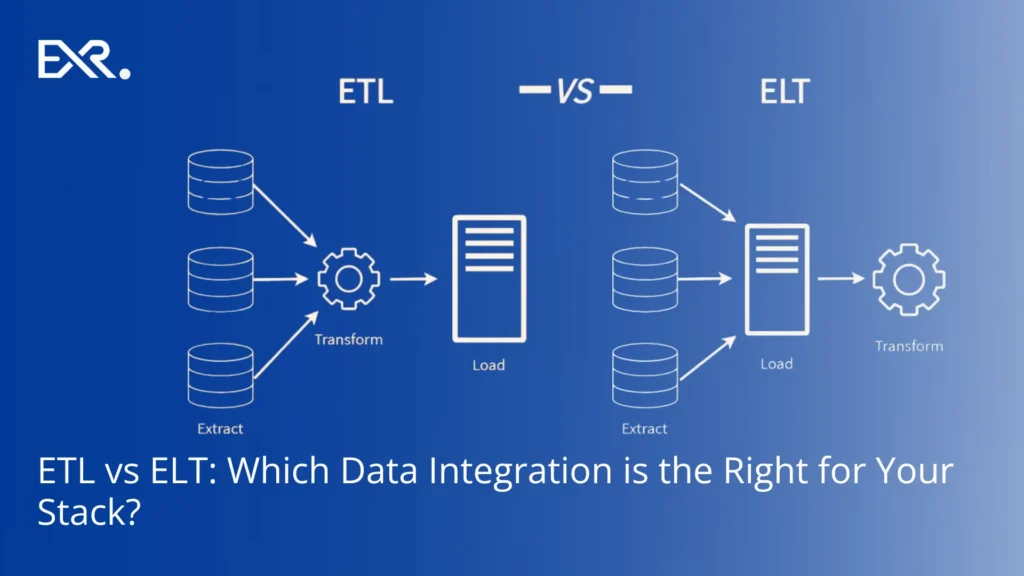

One of the most significant comparisons in modern data engineering is ETL vs ELT. These two techniques are employed to transfer data across various sources into a central system or data warehouse, including a data lake. They, however, vary in the way and location of data transformation.
Data transformation in ETL (Extract, Transform, Load) is done before storage in the warehouse. In ELT (Extract, Load, Transform), raw information is initially loaded and later transformed by the processing ability of the advanced cloud systems.
ELT is gaining popularity in the contemporary data stacks as firms move to cloud-based data warehouses such as Snowflake, BigQuery, and Redshift. Nonetheless, ETL remains a crucial factor in the setting that demands high-data governance and preprocessing.
This guide details the distinction between ETL and ELT, their designs, benefits, applications, and the process of selecting the perfect data pipeline method.
Key Takeaways
- ETL converts data before loading it into a warehouse.
- Raw data is loaded in ELT and converted in the warehouse.
- ETL can be found in old-fashioned and compliance-intensive systems.
- ELT has become a popular cloud data platform within modern and contemporary cloud platforms.
- ELT is more efficient with cloud warehouses such as Snowflake, BigQuery, and Redshift.
- The hybrid method, which combines both approaches, is currently being employed by many organizations.
ETL vs ELT: Side-by-Side Comparison Table
| Feature | ETL | ELT |
| Full Form | Extract Transform Load | Extract Load Transform |
| Transformation Stage | Before loading data | After loading data |
| Processing Location | External processing engine | Inside the data warehouse |
| Best Environment | Traditional data warehouses | Cloud data warehouses |
| Scalability | Moderate | High |
| Data Volume Handling | Suitable for structured data | Handles large-scale datasets |
| Performance | Slower for big data | Faster for large datasets |
| Flexibility | Less flexible | Highly flexible |
| Typical tools | Informatica, Talend, SSIS | Fivertran, Airbyte, dbt |
What is ETL (Extract, Transform, Load)?
ETL is a traditional data integration method used to prepare data before storing it in a data warehouse.
The process involves three stages:
- Get data out of various sources.
- Transform it into a consistent format.
- Insert the cleaned data into the warehouse.
ETL became popular when computing resources inside warehouses were limited.
The ETL Process Explained
The ETL workflow includes three key steps.
Extract
Data is collected from various sources such as:
- Databases
- APIs
- CRM systems
- SaaS applications
- Log files
Transform
The extracted data is cleaned and structured. Common transformations include:
- Removing duplicates
- Data validation
- Format conversion
- Aggregation
- Filtering
Load
The transformed data is loaded into a data warehouse where analysts and BI tools can access it.
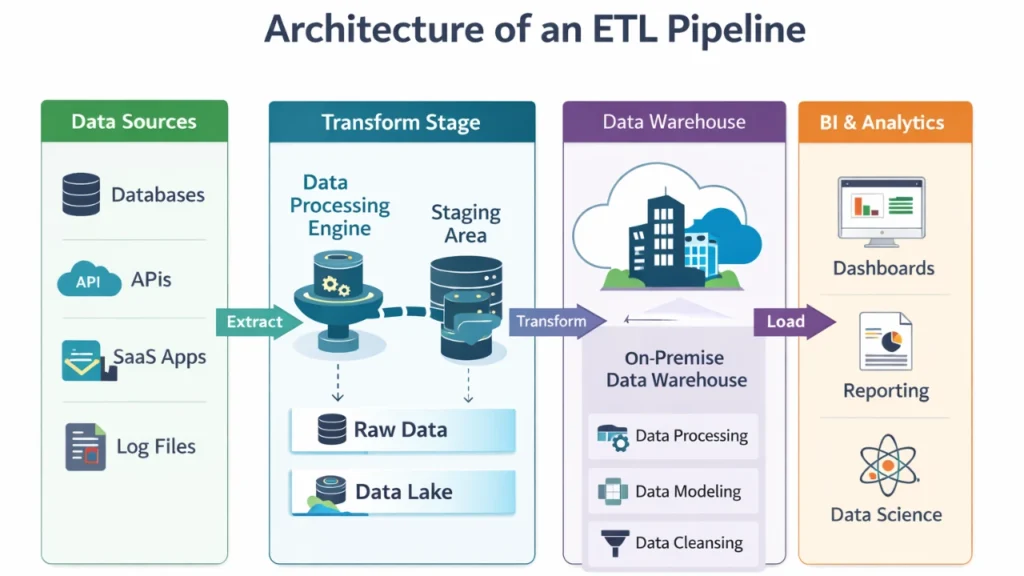
Architecture of an ETL Pipeline
A typical ETL architecture includes:
- Data sources
- Extraction layer
- Transformation engine
- Staging area
- Data warehouse
The transformation engine performs most of the heavy processing before the data reaches the warehouse.
Advantages of ETL
ETL offers several benefits:
Strong data quality control
Transformations occur before loading, ensuring clean datasets.
Compliance and governance
Sensitive data can be filtered before entering storage.
Efficient for structured data
ETL works well with predefined schemas.
Limitations of ETL
Despite its advantages, ETL also has drawbacks.
Slower processing for large datasets
Transforming data before loading can create bottlenecks.
Limited scalability
Traditional ETL systems struggle with large-scale data environments.
Complex pipeline management
Maintaining ETL pipelines can require significant engineering effort.
Discuss your goals, explore tailored solutions, and get actionable insights to drive real results. Schedule a 30-minute call today with our EXR Webflow experts!
What is ELT (Extract, Load, Transform)?
ELT is a modern data integration approach designed for cloud-based data platforms.
Instead of transforming data before loading, ELT loads raw data directly into the data warehouse. Transformations are performed later within the warehouse itself.
This approach leverages the powerful compute capabilities of modern cloud platforms.
The ELT Process Explained
ELT also involves three stages.
Extract
Data is extracted from sources just like in ETL.
Load
Instead of transforming data immediately, it is loaded directly into the data warehouse in its raw form.
Transform
Once stored, transformation logic runs inside the warehouse using SQL or transformation tools.
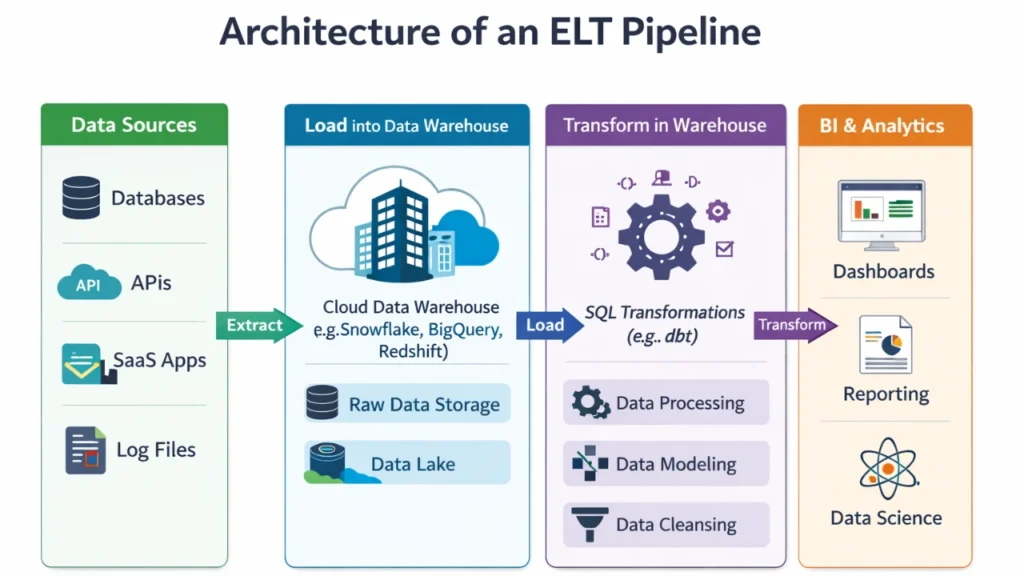
Architecture of an ELT Pipeline
An ELT architecture typically includes:
- Data sources
- Data ingestion tools
- Cloud data warehouse
- Transformation layer
The warehouse itself becomes the main processing engine.
Advantages of ELT
ELT offers several advantages in modern data environments.
High scalability
Cloud warehouses can process massive datasets.
Faster data ingestion
Data can be loaded immediately without waiting for transformation.
Flexible transformations
Teams can iterate on transformation logic without reloading data.
Limitations of ELT
ELT also has certain challenges.
Higher storage costs
Raw data is stored before transformation.
Requires powerful warehouses
ELT depends on cloud computing resources.
Governance complexity
Storing raw data may require stronger access controls.
ETL vs ELT: Key Differences
Here are some key differences:
Where Data Transformation Happens
ETL performs transformations before loading data.ELT performs transformations inside the data warehouse.
Performance and Processing Speed
ELT typically offers faster ingestion because raw data is loaded immediately. ETL may be slower due to preprocessing steps.
Scalability and Flexibility
ELT scales better in cloud environments. ETL pipelines can become complex when data volumes grow.
Infrastructure Requirements
ETL requires separate processing servers. ELT relies on the computing capabilities of modern data warehouses.
Cost Considerations
ETL requires dedicated processing infrastructure. ELT may increase warehouse compute costs, but simplifies pipeline architecture.
Data Governance and Compliance
ETL allows sensitive data to be filtered before storage. ELT requires strong access controls since raw data is stored in warehouses.
Read more: Data Lake Vs Data Warehouse
Performance Benchmarks in Modern Data Pipelines
Batch Processing vs Real-Time Processing
ETL pipelines often operate in batch mode. ELT supports both batch and near-real-time processing.
Data Latency and Pipeline Speed
ELT reduces latency because data becomes available immediately after loading. ETL introduces delays during transformation.
Impact on Data Processing Workloads
ELT shifts the workload to the data warehouse, making pipelines simpler. ETL distributes processing across multiple systems.
Cost Comparison Across Modern Data Warehouses
ELT with Snowflake
Snowflake supports scalable compute clusters for data transformations.
ELT with BigQuery
BigQuery provides a serverless architecture ideal for ELT workloads.
ELT with Amazon Redshift
Redshift offers powerful query engines for large-scale transformations.
Cost Trade-offs Compared to ETL
ELT reduces infrastructure complexity but may increase warehouse compute usage.
When to Use ETL vs ELT
The decision between ETL and ELT will be the question of your infrastructure, data volume, and business objectives. Both methods transfer the information among various sources to a central system; however, the manner of processing data makes them appropriate in various circumstances.
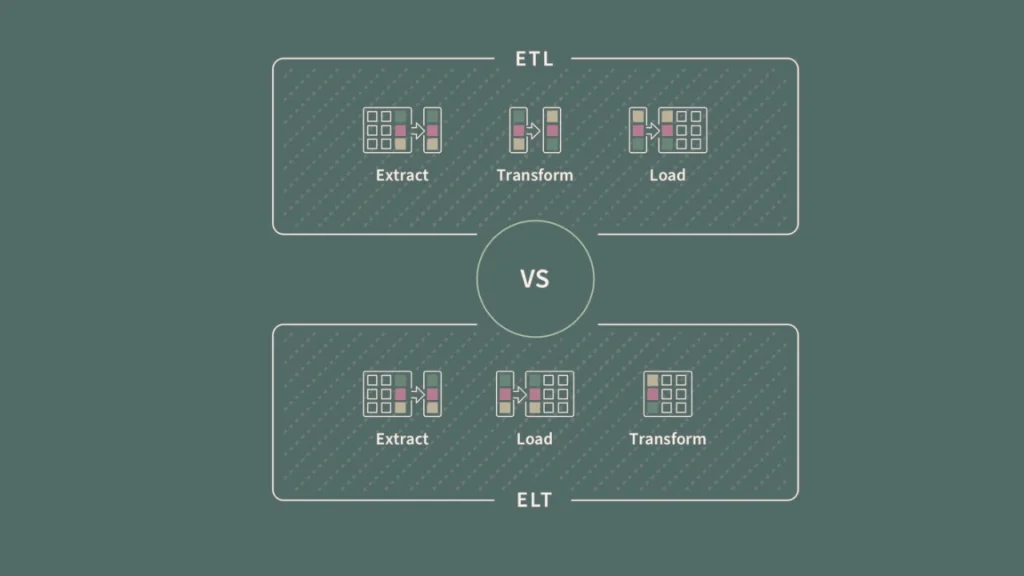
The knowledge of the most effective areas of application of each of them aids organizations in creating more efficient and scalable data pipelines.
Situations Where ETL Is the Better Choice
Using data transformation as a safe and more convenient alternative to loading it into the warehouse is still a good choice in certain settings.
Strict compliance environments
Such industries as finance, healthcare, and government are known to be working with highly sensitive data. ETL enables a group of people to clean, validate, and eliminate sensitive information and then store it. This facilitates the achievement of regulatory and compliance requirements.
Legacy infrastructure
A lot of businesses continue to use the on-premises data warehouses. Such systems are typically deficient in the processing power that is required to make heavy transformations within the warehouse. ETL is more suitable in this kind of environment since the transformation takes place before loading the data.
Predefined schemas
ETL can be used to ensure consistency in case the organization is in possession of an established data structure. The transformation step involves standardization of data, and reports and analytics tools get clean and structured data.
Situations Where ELT Is the Better Choice
ELT is the most favored choice of contemporary cloud-based data platforms since it enables companies to transfer and process masses of data in a short duration of time.
Large-scale analytics platforms
ELT is usually favored by organizations that must handle large volumes of data. Raw data can be loaded straight away, and transformations can be performed subsequently using the high-processing power of modern data warehouses.
Cloud-native data stacks
Cloud-based DWs like Snowflake, Google BigQuery, and Amazon Redshift are created to process transformations in the platform. This contributes to the fact that ELT is quicker and scalable.
Rapid Experimentation
In cases of data teams, there seems to be a need to test new transformation models or analytical queries. Under ELT, the raw data is already present in the warehouse, and therefore, analysts can test the transformations without rewriting the entire pipeline.
Hybrid Data Pipeline Strategies
The fact is that in most organizations, a single approach is not used. They would rather merge ETL and ELT to have the best of both.
As an example, sensitive or regulated data can be taken through ETL initially to guarantee adherence and quality. Meanwhile, massive blocks of application or user data can go through an ELT process to be ingested and analyzed more quickly and freely.
The hybrid strategy enables businesses to have good data governance yet enjoy the ability of the modern cloud data platforms to scale to high speeds.
Real-World ETL vs ELT Examples
ETL in Financial Data Systems
Banks often use ETL to validate and secure sensitive financial data before storage.
ELT in SaaS Analytics Platforms
SaaS companies rely on ELT to process large volumes of application data.
ELT in E-commerce Data Pipelines
E-commerce platforms use ELT to analyze customer behavior in real time.
Future of Data Integration: Will ELT Replace ETL?
Cloud adoption is causing ELT to expand fast. Nevertheless, regulation and old-fashioned systems continue to demand the crucial role of ETL.
Most probably, it might be in the form of a hybrid architecture that will make use of both styles in the future.
Transform your business with Generative AI. Work with our experts to innovate, optimize, and achieve real results. Get started now!
Wrapping Up
- Both ETL and ELT play crucial roles in contemporary data pipelines.
- ETL remains valuable for controlled environments with strict governance requirements.
- ELT is efficient in scalable and fast cloud-based data platforms.
- The selection of the most appropriate approach depends on the infrastructure, data volumes, and analytics requirements.
Frequently Asked Questions
Why is ELT more popular in cloud environments?
Cloud data warehouses provide scalable compute resources that make ELT efficient.
Is ELT faster than ETL?
ELT is often faster for large datasets because the data is loaded immediately.
How do ETL and ELT handle structured and unstructured data?
ETL usually deals with structured data, whereas ELT accepts structured and semi-structured data.
What role does compliance play in choosing between ETL and ELT?
Organizations handling sensitive data may prefer ETL because transformations occur before storage.
Can organizations use both ETL and ELT together?
Yes. Many modern architectures use hybrid pipelines combining ETL and ELT methods.