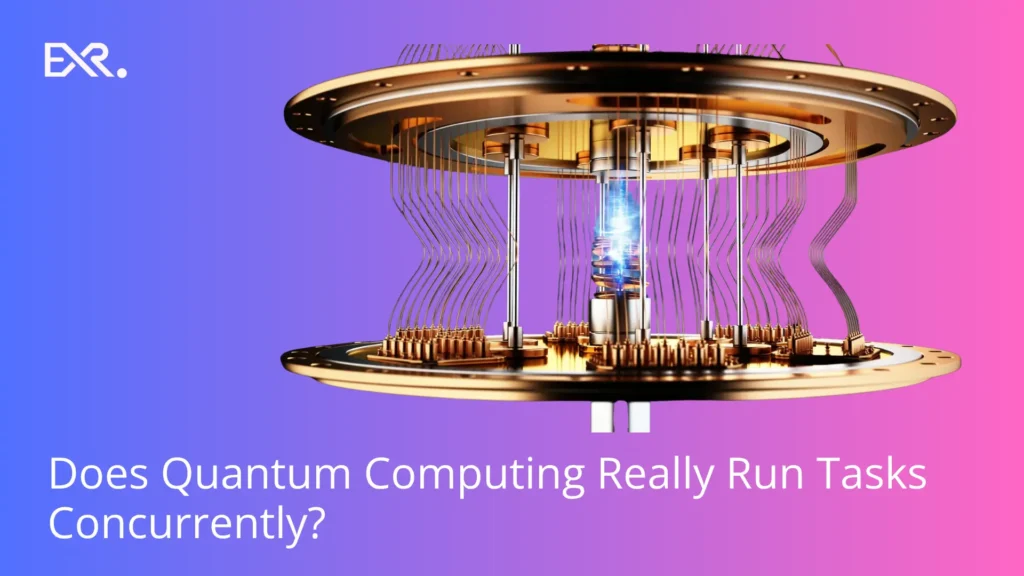

Quantum computing is changing the way complicated computations are done. Contrary to classical computers, which execute instructions sequentially or by several processors at a time, quantum computers are based on the laws of quantum mechanics, where information is controlled by quantum objects. The most frequent question in the field is whether quantum computing concurrency enables multiple tasks to be executed in real-time, by concurrency as classical parallel computing does.
It is necessary to learn this concept since the rules of quantum computing are quite different. Rather than applying independent procedures to different hardware cores, quantum systems operate on quantum states to search a large number of options on the same framework of computations. This is a feature that allows quantum computers to solve particular problems of a more efficient nature than classical machines.

Understanding Concurrency vs Parallelism
Classical Parallelism
In classical computing, parallelism is used when two or more processors or cores calculate different computations simultaneously. As an example, recent CPUs can split workloads across multiple cores, and thus the programs can be run faster through the sharing of workload across the physical hardware.
The processors independently execute a particular sequence of instructions. Although this makes the processing faster, it demands extra physical resources and scaling hardware.
Quantum Concurrency
Quantum computers work differently. Rather than splitting tasks among some processors, they have qubits, which are capable of being in a number of states at once because of Quantum Superposition.
It implies that a quantum computer is able to represent many computational possibilities simultaneously. The interaction of qubits by Quantum Entanglement allows the state of one qubit to become correlated with the other, allowing the system to process information together as a system instead of in isolation.
Due to these properties, quantum computing concurrency enables a quantum system to search through a large space of solutions in one computational step.
Want to bring your business ideas to life with AI? Partner with EXRWebflow and hire our AI developers to build customized AI solutions tailored to your business needs.
How Quantum Computing Concurrency Works
Concurrency of quantum computing is based on the mathematical form of qubit states.
Classical bit can be 0 or 1.
A qubit can, however, embody a mixture of the two states at the same time.
For example:
- Two states are the possible states of a 1-qubit
- 2 qubits represent 4 states
- 10 qubits represent 1024 states
The space of states is exponentially increased as the number of qubits increases. This allows a quantum processor to act on a great number of probability amplitudes in a calculation.
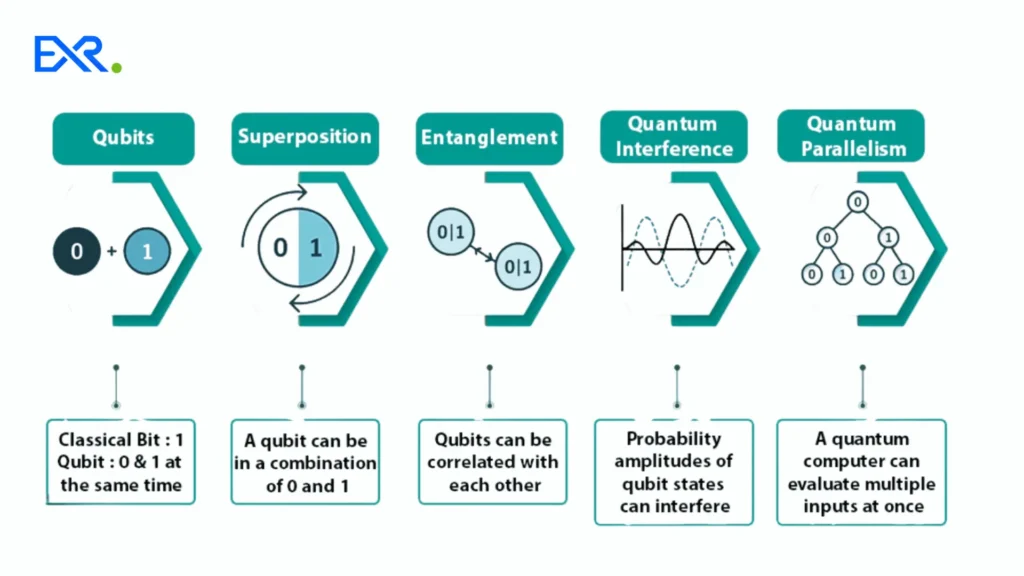
Nevertheless, quantum computers do not literally provide a simultaneous output of all results. Rather, they use a series of quantum interactions that act to convert probability amplitudes in a manner that the correct solution becomes highly probable on measurement of the system.
This is what creates the impression of concurrency. The quantum system is one that considers the existence of many computational pathways, and then it collapses to a final state when measured.
Quantum Parallelism vs Quantum Computing Concurrency
Quantum parallelism and quantum computing concurrency are two terms that are used interchangeably but they represent a bit different concepts.
Quantum parallelism The capability of a quantum computer to compute a function on many inputs simultaneously with only one quantum operation is known as quantum parallelism.
An example is that when a classical computer is trying to compute a function ( f(x) ), it is only calculating a single value of (x) at a time. Superposition enables a quantum computer to compute the function on a significant number of inputs at once.
On the other side, quantum computing concurrency is the way that the system manipulates and propagates multiple probability amplitudes during a quantum algorithm.
The difference here is that quantum computers do not execute parallel tasks. They instead act upon an overlay of states and change the whole system as a unit.
Example: Database Search with Grover’s Algorithm
An example that is known to exhibit concurrency in quantum computing is the Grover algorithm.
It is a quadratic faster algorithm used to search unsorted databases.
Take an example of a database that has 1 million records.
A traditional search method may take 1,000,000 operations to locate the right entry.
With the help of the Algorithm presented by Grover, a quantum computer can find the right item in about:
[ \sqrt{1,000,000} = 1000 ] operations.
This is done through the fact that a quantum system examines several possibilities at the same time by means of superposition. Amplification Probability of the correct solution is raised, and the probability of incorrect ones is reduced during the algorithm.
The quantum computer does not literally examine all entries simultaneously; however, it is a manipulation of probability amplitudes such that a vastly smaller number of computational steps is required.
Read more: Why Great Products Fail: Engineering, Strategy, and Leadership Lessons
Real-World Applications of Quantum Computing Concurrency
Concurrency in quantum computing is particularly applicable in solving complex problems that classical computers cannot solve.
Cryptography
Quantum computers have the potential to break the existing encryption. Simultaneously, they also make it possible to implement new security techniques, e.g., quantum key distribution.
Optimization Problems
Logistics planning, financial portfolio optimization, and traffic management are common optimization problems in the industries. Quantum algorithms are able to compare a greater number of possible solutions at the same time and find the best configurations more effectively.
Molecular and Chemical Simulation
The classical computers find it highly difficult to simulate molecules and chemical reactions due to quantum behavior that controls the systems. Quantum computers are more natural in modeling molecular interactions, which would speed up drug discovery and other materials science investigations.
Machine Learning
Quantum computing can be used to improve machine learning through the analysis of high-dimensional datasets and complex probability distributions in a more efficient way than classical algorithms.
Current Quantum Hardware and Concurrency Capabilities
Quantum computing equipment is in its infancy. The present period is commonly referred to as Noisy Intermediate-Scale Quantum (NISQ) period.
A number of large technology companies are in the process of developing quantum processors including:
- IBM
- Microsoft
- Intel
Qubinions: These are quantum computing systems that generally have tens or hundreds of qubits, making the scale of realistic quantum computing concurrency today.
There are a number of technical challenges that are faced by the researchers:
Decoherence
The levels of sensitivity of quantum states to environmental noise are very high. External factors may interfere with qubits before causing them to lose their quantum properties.
Error Rates
The quantum operations have errors. Even minor flaws may add up and have an impact on the final outcome.
Qubit Connectivity
Numerous quantum computations have qubits interacting with one another. Depending upon the hardware, communication with qubits is frequently limited because of hardware dependencies.
The solution to these limitations is to create scalable quantum computers that could simultaneously complete large-scale computations.
Hybrid Quantum-Classical Computing
In the nearest future, quantum computers will not be able to fully substitute classical computers. They will instead work under hybrid computing systems.
Under this model, the functions of classical computers are to prepare the data, data control logic, and optimization loops, and the computationally intensive tasks are performed by quantum processors.
An example of a standard hybrid workflow can be:
- Calculating the input data on a classical computer.
- Executing a quantum algorithm in a quantum processor.
- Measuring the output state
- Refining the results with the help of classical processing.
This hybrid approach was used by algorithms like the Variational Quantum Eigensolver (VQE) and the Quantum Approximate Optimization Algorithm.
This collaborative architecture enables quantum computing concurrency to supplement the classical computing power and not to substitute it.
Challenges and Limitations
Quantum computing concurrency has great potential, but it is not without significant challenges.
Hardware constraints: The number of qubits and coherence time are limited in the existing quantum processors.
Quantum error correction: Scalable fault-tolerant quantum computing necessitates sophisticated error correction methods that are yet to be established.
Design of algorithms: A lot of quantum algorithms are sophisticated and must be optimized accordingly to be better than the classical algorithms.
Due to these difficulties, there is still ongoing research on practical large-scale quantum computing.
Future Outlook
Improvement of qubits, scalability of hardware and error control of quantum computing remain key challenges to the future of quantum computing concurrency.
With the development of these technologies, quantum computers can bring breakthroughs in areas like:
- pharmaceutical research
- climate modeling
- high-tech materials engineering.
- financial risk analysis
- artificial intelligence
The huge quantum systems have the potential to change industries in that it is able to solve computational problems that cannot be solved by classical supercomputers at the present time.
Future Tech Discovery. Schedule a 30-Minute Call with Our Experts to Explore AI-Driven Solutions and Turn Your Business Ideas into Scalable Digital Innovation.
Conclusion
The quantum computing concurrency is a completely new computational paradigm as compared to classical parallel processing.
Rather than performing superpositions of states and computing probability amplitudes of a large number of potential solutions, quantum computers interact with superpositions of many states and dynamically act on probability amplitudes.
Although the present quantum equipment is still in its infancy, further studies and technical development have been gradually improving the industry.
The special benefits of quantum computing concurrency may bring the power of quantum computing to science, technology, and industry as quantum processors become more stable and scalable.
Frequently Asked Questions
What is quantum computing concurrency?
Quantum computing concurrency refers to the ability of quantum systems to explore multiple computational possibilities simultaneously using quantum mechanical properties such as superposition and entanglement.
Is quantum concurrency the same as classical parallel computing?
No. Classical parallel computing runs separate tasks on multiple processors, whereas quantum concurrency manipulates multiple probability states within a single quantum system.
What algorithms use quantum concurrency?
Several quantum algorithms exploit this capability, including Grover’s Algorithm and other optimization and simulation algorithms.
Can quantum computers replace classical computers?
Not entirely. Quantum computers are best suited for specialized tasks, while classical computers will continue to handle general-purpose computing.