
Computer vision is changing the way businesses and governmental organizations achieve computer vision operational efficiency in their operations.
With the ability to recognize images and video in real time, organizations can automate inspections, monitoring, document processing, and tracking of assets, which saves the organization money and provides more speedy and accurate results.
In contrast to the manual visual analytics that is used, AI-enabled visual analytics operates 24/7, analyzes thousands of data points in a second, and provides consistent output.
What it means is that the result is a smarter workflow, faster decision-making, and scalable operations.
What Does Computer Vision Operational Efficiency Mean?
Computer vision operational efficiency is defined as the application of AI-powered image and video analysis to automate workflows, eliminate human error, and enhance decision-making.
Real-time monitoring systems are implemented in institutions instead of manual ones, where defects are detected, inventory is tracked, risks identified, and automated actions are performed. This minimizes the time taken in the operating cycles and helps in proactive management.
Simply put, it transforms cameras and sensors into smart systems that would contribute to quantifiable business outcomes.
Computer Vision vs Traditional Processes
What is Computer Vision?
Computer vision is a developed science of artificial intelligence that enables machines to automatically read, interpret, and analyze visual image data on images, videos, or live camera feeds.
With the help of algorithms, deep learning, and neural networks, it has an opportunity to detect objects, recognize patterns, identify defects, track movements, and even predict results in real time.
What are Traditional Processes?
Traditional processes refer to manual ways of inspection, monitoring, or checking of duties by humans. These are based on human judgment, experience, and observation to identify defects, count items, or provide compliance.
As an example, they can be a quality inspector who checks the products in an assembly line, or security or surveillance cameras for suspicious activity.
These are slower processes that are more prone to errors by people and are restricted by the number of staff and time. Expansion of operations involves more recruiting and training, which makes it more expensive and time-consuming.
| Aspect | Computer Vision | Traditional Processes |
| Speed | Faster image analysis is capable of examining 100 or more items a second. | One to 10-20 items are inspected per minute by a human. |
| Accuracy | Frequently, more than 99%, and with a steady outcome. | Under normal conditions the defect miss rate is 20-30% under normal conditions. |
| Consistency | No fatigue; not affected by 24/7. | Fatigue causes performance to reduce. |
| Scalability | Scales using cameras and computing structures. | Needs to recruit and educate employees. |
| Cost Efficiency | Reduced the long-term cost of operation. | Increased recurring labour expenses. |
Key Applications Across Industries
Manufacturing and Quality Control
The visual check of AI allows complete inspections of the product at the production rate. It lowers the number of defects and waste levels and facilitates predictive maintenance.
Supply Chain and Logistics
Inventory monitoring, automatic verification of picking, and freight checking enhance efficiency and minimize waste in the warehouse.
Safety and Infrastructure Monitoring
Intelligent monitoring solutions identify safety breaches, risks of equipment, and damage of structures in real-time. Drones are employed in bridge, road, and utility inspection by governments.
Retail and Loss Prevention
The computer vision helps minimize shrinkage, enhance the accuracy of inventory, and the customer behavior to optimize the layout of stores.
Public Sector Operations
Agencies automate the process of document verification, detecting fraud, tracking traffic, and managing smart city infrastructure.
Talk to Our AI Experts Today. Discover How Computer Vision Can Boost Your Operational Efficiency. Contact Us for a Personalized Consultation.
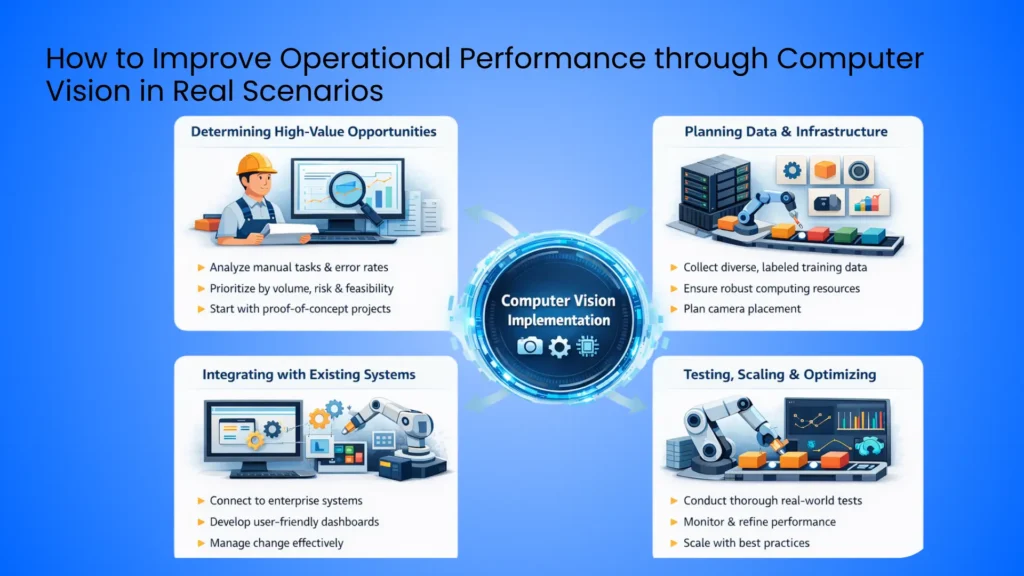
How to Improve Operational Performance through Computer Vision in Real Scenarios
Determining High-Value Opportunities
Effective implementation starts with determining the areas where the technology is most effective. Visual tasks to be done by hand: inspections, monitoring, counting, and checking.
Measure the man-hours, error rates, and the mistake costs downstream. Rank by volume (processes with thousands of items per year), risk (cost of errors or safety of potential errors), and reality (technical ease).
Involve frontline employees- they know what is painful and inefficient, which cannot be seen on paper.
Begin with projects of proof of concept that are large enough to illustrate value but can be handled with risk. One production line or warehouse facility could test technology and develop expertise, and then roll out bigger.
Planning Your Data and Infrastructure
Systems need training data, thousands of labeled images of conditions, defects, objects, or situations that they are to identify.
Collect data early, with it being a full range of variation: lighting, angles, product changes, and background. The quality of data defines the performance of a system.
Photographs should be depictive, clear, and labeled. The preparation is an area that is underestimated by organizations. Use synthetic data generation or pre-trained model transfer learning to minimize requirements.
Infrastructure requires sufficient computing infrastructure- edge devices to process in real-time, or a cloud server to do centralized processing. The placement of the camera must be planned in terms of coverage, resolution, frame rates, lighting, and the environment.
Integrity with Existing Systems
Computer vision should be part of the enterprise systems in order to provide value. Defect detection inspection systems require manufacturing execution system interfaces to stop production.
Warehouse management systems have to be updated in terms of inventory monitoring. Early plan integrations- they are usually the majority of implementation complexity.
Older systems might not have current APIs and, therefore, have to be developed. And human interfaces, as well-operators require dashboards that show actionable insights.
It is important to have change management. Individuals who are used to working manually will require training on how to work with automated systems, interpretation of outputs, and management of exceptions.
Testing, Scaling, and Optimizing
Detailed testing under conditions of production is necessary. Systems that can work in controlled environments may fail in variable conditions. Test over complete condition conditions: times of the day, weather, product changes, working conditions.
Make performance measurements before the test. What is good acceptability? What response time is required? Unambiguous success standards eliminate any uncertainty regarding the state of production.
The optimization is sustained after the deployment. Systems produce voluminous performance information that shows areas of improvement.
Ongoing measuring and improvement focus on long-term value. The lessons learned should be used to create standardized playbooks that contain best practices and leverage scaling.
Learn more: https://exrwebflow.com/artificial-intelligence-ai-solutions-company/
Common Challenges
Managing Data Quality and Bias
Data quality challenges plague implementations more than technical limitations. Systems trained on biased data perpetuate biases in production.
Address through deliberate data diversity, ensuring training encompasses full condition ranges. Implement robust validation. Human review catches labeling errors before contaminating training.
Regular audits reveal drift or bias developing as conditions change. Continuous retraining addresses drift operational condition shifts, degrading performance over time.
Addressing Integration Complexity
Integration challenges determine whether implementations succeed or become expensive pilots that never scale. Adopt platform approaches with consistent interfaces rather than point solutions.
Use middleware providing adapters for common enterprise systems. Start with a standalone value where possible. Some applications deliver benefits without deep integration.
Once proven valuable, pursue deeper integration. Plan for iteration, initial implementations might use simple exports, with automation increasing as understanding improves.
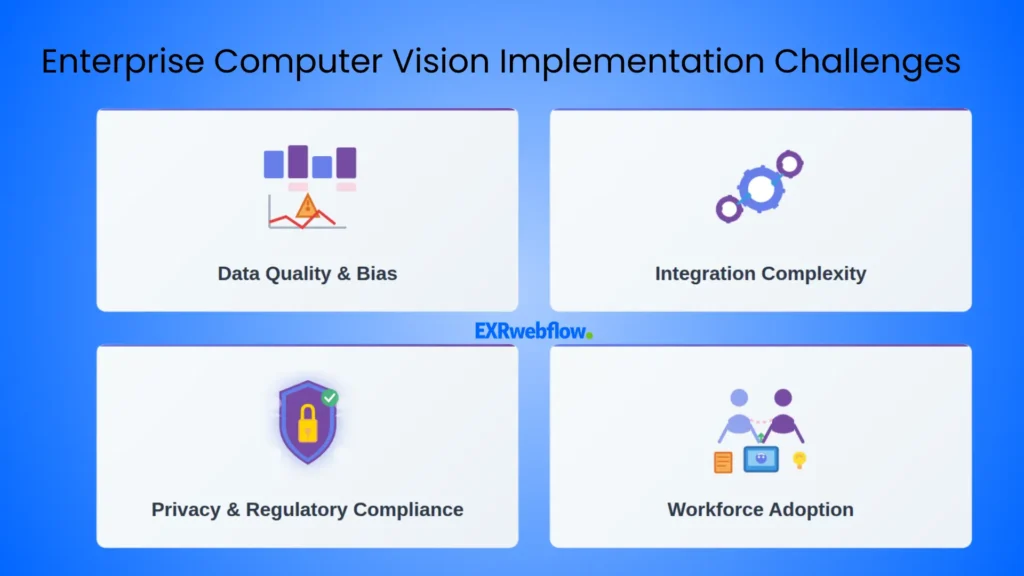
Ensuring Privacy and Regulatory Compliance
Privacy concerns create legitimate resistance and regulatory constraints. Address proactively through privacy-by-design, minimizing data collection, retention, and access while achieving objectives.
Implement privacy-preserving techniques. Use anonymization when identity isn’t necessary. Process data at the edge, retaining only analytical results.
Establish clear governance policies covering collection, retention, access, and usage. Regulatory compliance requires understanding varying jurisdictional and industry requirements.
Engage legal expertise early, ensuring compliance, avoiding costly retrofitting. Worker consultation mechanisms build trust and satisfy regulatory requirements.
Supporting Workforce Adoption
Human factors determine whether systems deliver potential value. Address job security concerns directly. Highlight how computer vision transforms rather than eliminates jobs.
Inspectors become quality analysts, security guards become coordinators. Invest in training beyond basic operation. Help workers understand how systems work, their limitations, and output interpretation.
Design systems augment rather than replace judgment where possible. Collect and act on user feedback. Frontline workers notice system quirks and improvement opportunities that developers miss. Demonstrate responsiveness by implementing suggestions.
Ready to Modernize Your Data Infrastructure? Partner with EXRWebflow Experts for Reliable, Scalable, and Efficient Data Engineering Services.
Conclusion
Computer vision is no longer a trial technology but has established itself as an effective technology in enhancing the operational efficiency of enterprise and government AI systems.
Through automated visual working and bolstering real-time analytics, and offering predictive insight, the organizations save costs while enhancing quality, safety, and performance.
Investors in computer vision are creating smarter and more resilient operations today to be used in the future.
Frequently Asked Questions
What does computer vision operational efficiency mean?
It is the application of visual recognition that is powered by AI to automate activities, cut expenses, and enhance operational performance.
Which industries benefit most?
The greatest ROI is in manufacturing, logistics, retail, healthcare, utilities, and agencies in the public sector.
What ROI can organizations expect?
The payback period in most of the implementations is 12-24 months, particularly in quality inspection and inventory management.
How long does implementation take?
Even simple deployments can be completed in 2-4 months; large enterprise or government applications can require 12 months or longer.