
Software development has turned out to be erratic; today you plan something, but the next day it will be outdated. Alteration of user requirements, the development of technologies, and market pressure require a different approach.
This is where Adaptive Software Development (ASD) stands out, enabling teams to embrace change instead of resisting it.
What is Adaptive Software Development?
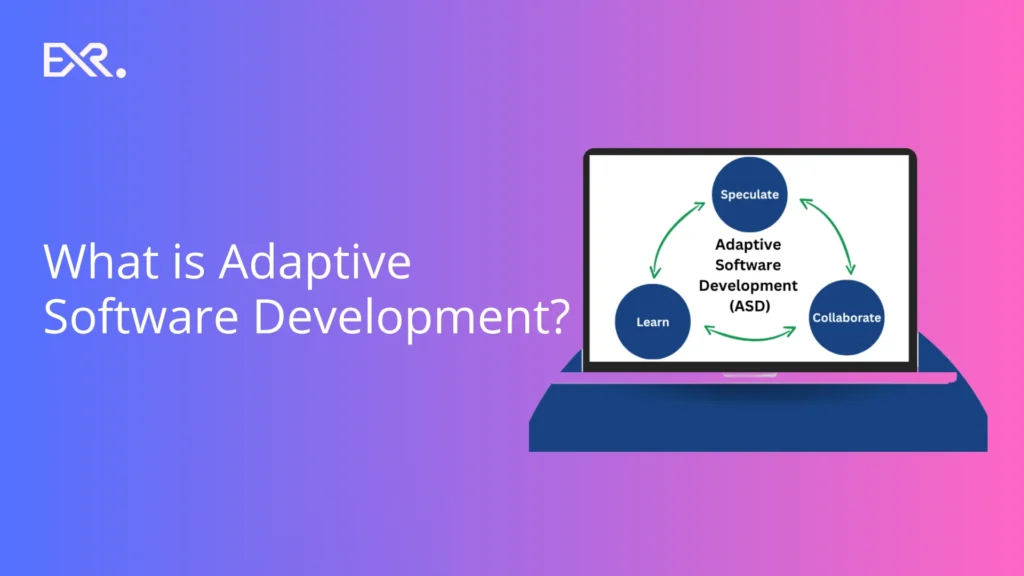
Adaptive Software Development (ASD) is an agile-oriented approach, which emphasizes flexibility, continuous learning and collaboration to manage the changing requirements throughout the development of a software.
It was derived from Rapid Application Development, and it was invented by Jim Highsmith and Sam Bayer during the early 1990s.
Contrary to the conventional practices, Adaptive Software Development presupposes that:
“Change is not an issue; it is a normal aspect of development.”
ASD discourages planning and strongly relies on a cyclical process and feedback to improve software as it progresses.
Why Adaptive Software Development Matters
Software projects in the modern world are run in unpredictable conditions:
- There are changing requirements
- The market environment is changing very fast
- The expectations of the customers change continuously
ASD can overcome these problems by enabling teams to:
- Change fast to meet new demands
- Provide value at smaller intervals
- Study and get better at everything
This renders ASD especially applicable to dynamic and innovation-driven projects.
Want to build flexible and future-ready software? Contact us today to implement Custom Software Development in your project.
Core Principles of Adaptive Software Development
ASD is developed following several main principles, which are used to implement it:
1. Adaptability Over Predictability
Rather than resorting to a set of plans, ASD helps the teams to adapt to real-time feedback.
2. Continuous Learning
Each iteration offers feedback that increases future development.
3. Customer Collaboration
The involvement of users during the process makes the product meet real needs.
4. Iterative Development
Software is developed in small chunks as opposed to a big release.
Adaptive Software Development Lifecycle
The methodology is based on the ASD lifecycle. It is divided into three repetitive overlapping stages:
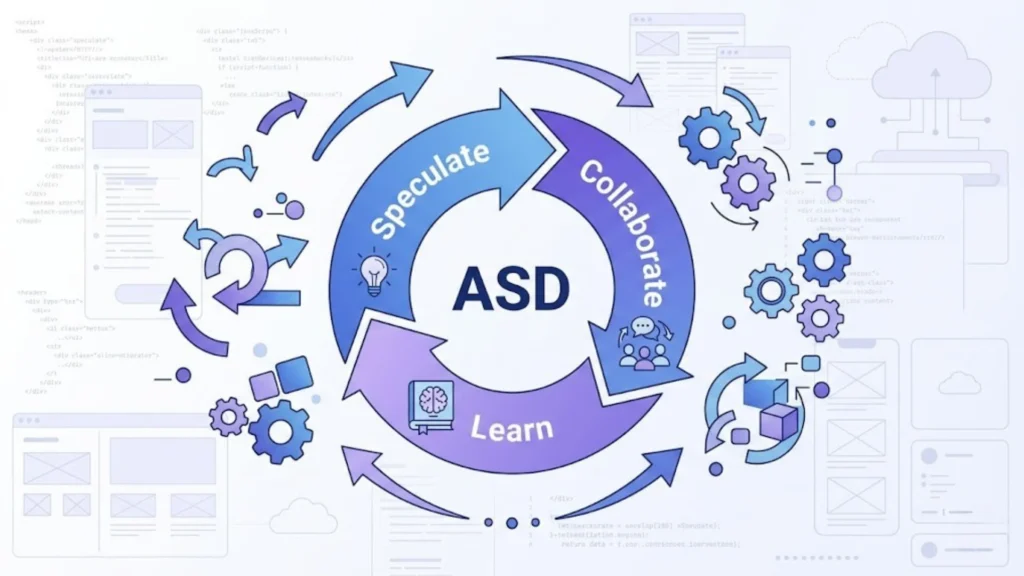
1. Speculation (Planning Phase)
This stage substitutes the conventional elaborate planning.
Key activities:
- Identify project vision and objectives
- Determine top-level requirements
- Make estimates of risks and constraints
- Create a flexible roadmap
In contrast to the fixed plans, speculation will tolerate that:
- The assumptions might be initial and false
- Requirements will evolve
This enables the teams to be flexible in the first place.
2. Collaboration (Execution Phase)
The stage aims at collaboration and action.
Key activities:
- Cross-functional teamwork
- Continuous communication
- Iterative development
- Quick product designs and tests
ASD promotes:
- Shared responsibility
- Open communication
- Real-time problem solving
There is no working silo; teams work closely, hence result in improved outcomes.
3. Learning (Improvement Phase)
The most essential stage of ASD is learning.
Key activities:
- Get user and stakeholder feedback
- Compare the results of every iteration
- Determine errors and enhancements
- Optimize future development cycles
Learning happens through:
- Reviews
- Testing
- Feedback loops
This guarantees a gradual and enhanced quality of products in the long run.
Key Characteristics of Adaptive Software Development (ASD)
Mission-Focused
- A clear business objective or mission determines development.
- Assures that all activities are geared towards the provision of real value and not waste features.
Feature-Based
- Functional (feature) Software is constructed in small building blocks.
- Both features are value additions and can be tested separately.
Iterative
- The process of development occurs in cyclic forms (iterations).
- Every cycle comprises planning, development, testing, and feedback.
Time-Boxed
- Each iteration is completed within a specified period.
- Helps are disciplined, do not procrastinate, and are punctual.
Risk-Driven
- Risk identification and risk mitigation at early stages.
- Minimizes the possibility of significant breakdowns in the future.
Change-Tolerant
- Embraces the fact that requirements are going to be dynamic.
- The teams are able to change and adjust easily without interfering with the whole project.
Benefits of Adaptive Software Development
1. Faster Time-to-Market
They can be delivered faster with short iterations.
2. Improved Product Quality
There is constant testing and feedback, which enhances quality.
3. High Flexibility
The adjustment to changes can be achieved without interfering with the whole project.
4. Better Collaboration
Promotes collaboration among the developers, designers, and stakeholders.
5. Customer-Centric Approach
The product is made to meet the expectations of the user with frequent feedback.
6. Reduced Project Risk
The failure risks are reduced through early identification of the problems.
Struggling with changing project requirements? Let’s help you build scalable software solutions.
Challenges of Adaptive Software Development
Even with all its benefits, ASD has certain limitations:
1. High User Involvement
Needs constant user-feedback, which can be hard to maintain.
2. Increased Costs
Repeated testing and iterations may increase the cost of development.
3. Scope Creep
The continuous communication of feedback can result in the uncontrolled growth of requirements.
4. Complexity in Large Teams
In large multi-project environments, coordination is a challenge.
5. Documentation Issues
It has become difficult to keep detailed documentation due to the rapid changes.
ASD vs Other Software Development Models
ASD vs Waterfall
| Feature | ASD | Waterfall |
| Flexibility | High | Low |
| Planning | Adaptive | Fixed |
| Development | Iterative | Sequential |
| Change Handling | Easy | Difficult |
Conclusion: ASD is better for dynamic projects, while Waterfall suits stable requirements.
ASD vs Scrum
| Feature | ASD | Scrum |
| Structure | Flexible | Structured |
| Roles | Less defined | Clearly defined |
| Approach | Adaptive | Sprint-based |
Conclusion: ASD offers more flexibility, while Scrum provides better structure.
ASD vs DSDM / XP
- DSDM is concentrated on strict schedules and management.
- XP (Extreme Programming) puts more emphasis on customer feedback and coding.
- ASD focuses on flexibility and constant education.
When Should You Use Adaptive Software Development?
ASD is ideal when:
- Requirements are uncertain or changing
- Rapid delivery is required
- Continuous user feedback is available
- Innovation and experimentation are important
Best Use Cases
- SaaS product development
- AI/ML applications
- Startup MVPs
- Digital transformation projects
When NOT to Use Adaptive Software Development
ASD may not be suitable if:
- Requirements are clearly defined and stable
- Limited user involvement is available
- Strict budgets and timelines must be followed
- Teams are not comfortable with uncertainty
Best Practices for Implementing Adaptive Software Development
1. Encourage Collaboration
Ease interdepartmental silos and open up to teamwork.
2. Use Short Iterations
Maintain small cycles so that you can get responses fast and improve.
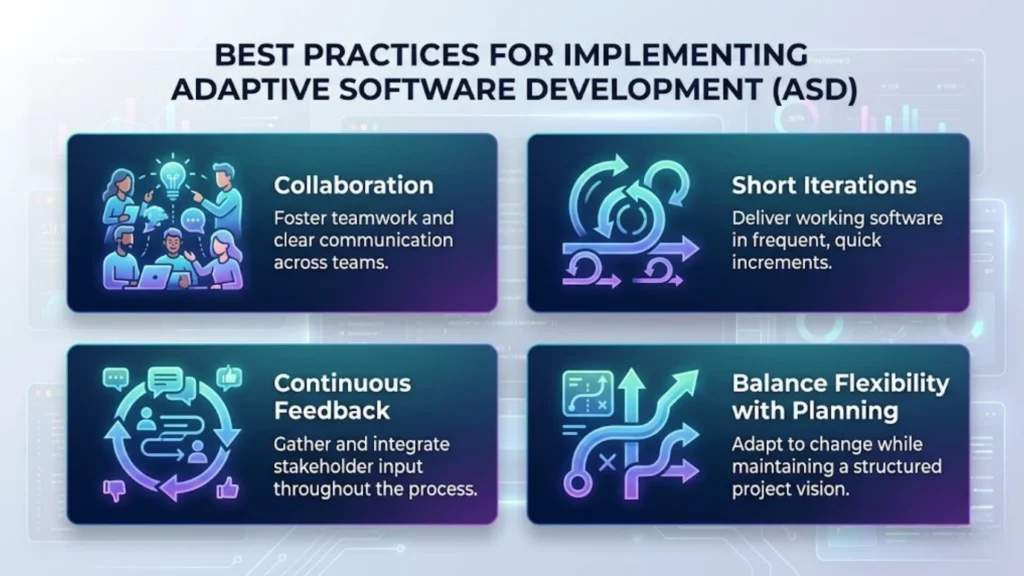
3. Focus on Continuous Feedback
Engage users on a regular basis in order to improve the product.
4. Balance Flexibility with Planning
Ensure that there is a high-level roadmap, but with flexibility.
Key Takeaway
Adaptive Software Development is not a methodology; it is an attitude.
ASD: Instead of fighting change, resisting it:
- Embraces uncertainty
- Encourages learning
- Promotes collaboration
This renders it one of the most efficient methods of software development in the present day.
Schedule a 30-minute call to discuss how Agile methodologies can improve your product development process.
Conclusion
Adaptive Software Development (ASD) presents an effective method of creating software in the modern uncertain world. Through its emphasis on flexibility, teamwork, and lifelong learning, it helps teams to produce high-quality user-friendly products.
Although it carries side effects such as higher costs and reliance on user feedback, it can be well tailored to fit the needs of modern development, which is its advantage.
ASD may be the solution when your project requires rapidity, novelty, and flexibility.
Frequently Asked Questions
What is adaptive software development?
It is a flexible approach to building software that allows changes during development and focuses on continuous improvement.
What are the 3 phases of ASD?
Speculation
Collaboration
Learning
How is ASD different from Agile?
ASD is a type of agile methodology but places a stronger emphasis on adaptation and learning rather than structured frameworks.
Is ASD suitable for all projects?
No. It works best for dynamic and evolving projects, not for fixed and predictable ones.