
The current era of high-speed business operations has placed more pressure than ever before on organizations to become highly efficient, economical, and provide excellent customer experiences. Paper-based processes, old systems, and disjointed workflows are not sustainable any longer.
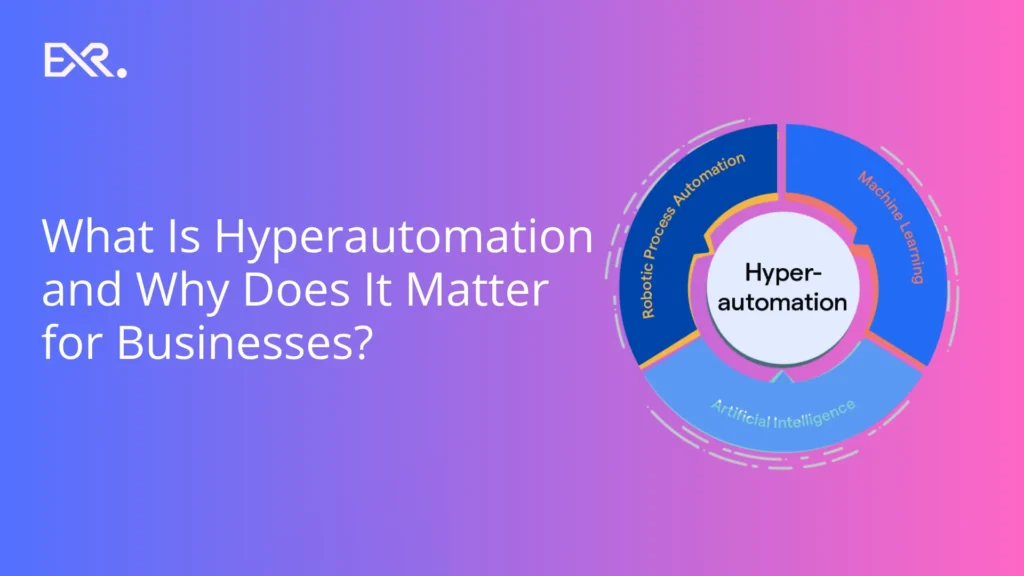
Meet hyperautomation, a strategic model that supports robotic process automation (RPA), artificial intelligence (AI), machine learning (ML), and process mining to end-to-end automate complex business processes.
One of the primary strategic trends that Gartner listed in 2020 is hyperautomation, and it is continuing to dominate the stage as companies fight to keep pace with the competition in 2026.
Hyperautomation is not merely an upgrade in technology but a business transformation technique that helps firms work more intelligently, quickly, and more precisely, finding new value in data on operations and human understanding.
What is Hyperautomation?
Hyperautomation refers to the coordinated application of many automation technologies to automate as many business processes as possible, and as swiftly and efficiently as possible.
Unlike traditional automation or RPA, which are concerned with simple and repetitive work, hyperautomation goes beyond it and uses AI, ML, and advanced analytics to streamline, control, and progressively enhance processes.
The simplest kind of hyper automation is:
- Robotic Process Automation (RPA): This is used to automate repetitive tasks based on a set of rules.
- Artificial Intelligence (AI) and Machine Learning (ML): It is possible to make decisions, anticipate information, and even analyze natural language.
- Process Mining/ Task Mining: Identifies the automation possibilities within the workflow based on an analysis of operational data.
- Integration Platforms: Integrates both disconnected systems, applications, and data sources.
- Low-Code/No-Code Tools: Provides business operators with the option to develop and edit automations without a programming background.
Example: A typical RPA bot would be used for invoice processing to process invoice data.
Hyperautomation goes even further, compliance is checked by AI, decision models send approvals to routes, and process analytics streamline the workflow throughout the departments, automating the process completely.
In brief, hyperautomation leads to businesses that are reactive and manual turning to agile, data-driven, and scalable organizations.
Ready to transform your business with hyperautomation? Integrate RPA, AI, and process mining to streamline workflows, cut costs, and boost efficiency. Our experts will help you identify high-impact opportunities and build a scalable strategy.
How Hyperautomation Works
Hyperautomation is a system based on a methodology that guarantees maximum efficiency and ROI:
Locate and investigate Processes
The first step that businesses take is to map their current workflows in order to determine repetitive, rule-driven, and time-sensitive activities. Process mining and task mining tools are used to analyze operational data in order to identify the possibility of automation. This is the step that makes organizations concentrate on high-impact processes initially.
Automate and Orchestrate
After identifying processes, RPA, AI, ML, and workflow management tools are used in combination. Some activities can be addressed using a simple RPA, and others can be resolved using intelligent automation similar to human judgment and decision-making.
Integration platforms are the systems that bind the different systems together to enable end-to-end automation.
Monitor and Optimize
Constant surveillance is important. With business process management (BPM) and analytics, companies are able to track the performance of automation, detect bottlenecks, and make workflow adjustments to the most efficient possible. Hyperautomation becomes more intelligent, smarter, and more able with time.
Key Takeaway: Hyperautomation is not a project; it is a process that requires constant improvement as AI and analytics smooth out the processes to reach the optimum level of efficiency.
Benefits of Hyperautomation
By implementing hyperautomation, organizations incur both real and strategic advantages, such as:
- Efficiency and Speed: Automates complicated processes, shortens cycle time, and speeds up operations.
- Precision and Conformity: Removes human error and generates audit trails to conform to regulations.
- Cost Reduction: Reduces the number of people who need to be hired as manual laborers and is efficient in the use of resources.
- Agility: Can quickly change its position in the market by adjusting to changes, scaling, and adopting new workflows.
- Innovation: It liberates employees from monotonous work and allows them to concentrate on strategic efforts.
- Advanced Customer Experience: Allows providing quicker responses, personal interactions, and uniform service provision.
Example: Hyperautomation in supply chain management enables organizations to monitor inventory, automatically order, and plan routes more efficiently and cheaply, but with better service quality.
Hyperautomation Real-World Use Cases
Hyperautomation does not depend on the industry, as it affects multiple departments and sectors:
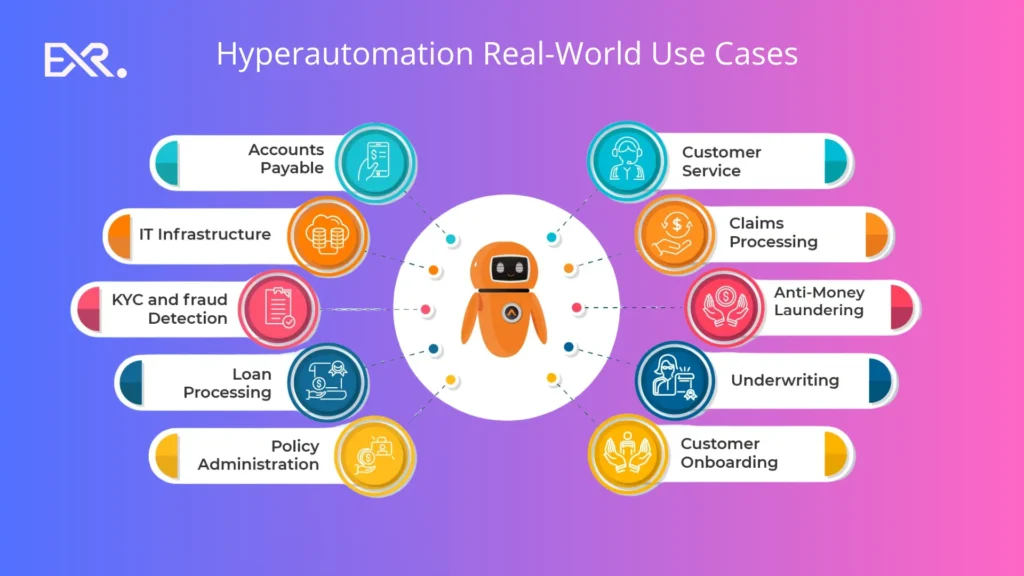
Finance and Accounting:
Automates purchase, payroll and account payable and financial reconciliations.
Human Resources:
Automates recruit-to-retire processes, employee on-boarding and employee benefit administration.
Customer Experience:
Chatbots with AI capabilities can respond to customer queries, and RPA can deal with document sorting and authorizations.
Supply Chain Management:
Automation of end-to-end processes such as demand planning, order fulfillment, and logistics.
Healthcare:
Automated claims, patient information and regulatory reporting.
The automation across departments makes sure the systems are interconnected to enhance operational stability and efficiency.
Leading Hyperautomation Platforms
The selection of the appropriate platform is key to success. The best hyperautomation systems are:
- UiPath: Provides RPA, AI suite, Task Mining, Document Understanding, and citizen development solutions.
- SAP Build Process Automation: AI-enhanced automation of enterprise processes in the ERP, HR and supply chain.
- Oracle Cloud Infrastructure (OCI) Process Automation: Uses if to link applications, automate approvals, and uses AI services to power complex workflows.
- Blueprint: Localizes RPA management, governance, and automation planning on an enterprise scale.
- Auxis and Grant Thornton: Provide hyperautomation consulting-delivered solutions based on business strategy.
These platforms are end-to-end, which allows organizations to go beyond the simplistic bots in automation.
Best Practices for Hyperautomation
To maximize their ROI, businesses need to:
- Identify High-Impact workflows: Focus on repetitive processes, time-intensive processes, or processes that involve errors.
- Add AI and Analytics: AI/ML to be able to make decisions and predictively.
- Governance and Center of Excellence (CoE): Possess clear ownership, standards and governance of automation projects.
- Repeat, Repeat, and Repeat: Optimize and scale automations as you proceed.
- Upskill Employees: Employees should be given the skills to participate in automation using low-code/no-code solutions.
These best practices will make hyperautomation provide long-term business value and not short-term solutions.
Turn your ideas into custom software that improves efficiency and accelerates growth. Our team builds secure, scalable, and user-focused solutions.
Challenges of Hyperautomation
Although the usefulness of hyperautomation is enormous, it is fraught with difficulties:
Legacy Systems:
Applications that are older might not be capable of integration or automation.
Data Management:
Clean and reliable data is essential to AI and ML-based automation.
Change Management:
The employees can be opposed to automation because they fear losing their jobs or they feel that it is too complex.
Security and Compliance:
Several intertwined systems could increase the exposure to cyber threats.
Price and Proficiency:
End-to-end hyperautomation is an expensive project that includes investing in technology and human resources.
Resolution:
These challenges can be cleared with the help of strong governance, communication plans, employee upskilling, and staged adoption plans and guarantee ROI.
The Future of Hyperautomation
Hyper automation is not a trend anymore; it is the pillar of contemporary digital transformation. Future trends include:
Artificial Intelligence-Driven Decision Making
Intelligent business decisions will be made in real-time by bots.
Enterprise-Wide Adoption
Organizations will stop having standalone automations and will instead have end-to-end workflows.
Shrewd Process Orchestration
RPA plus AI and predictive analytics to streamline operations in real time.
Improved ROI
Gartner estimates operations costs might also go down as much as 30 percent with hyperautomation, with fully restructured processes.
Human + Machine Collaboration
Human employees concentrate on value-added and creative activities, whereas bots are used to do repetitive and rule-based jobs.
Organizations that adopt hyperautomation in the modern world will not just enhance efficiencies in their operations, but also achieve a competitive edge in the competitive market.
From prompt design to optimization and testing, hire expert prompt engineers to build high-performing AI workflows tailored to your use cases. Improve accuracy, consistency, and overall AI performance with proven strategies.
Conclusion
Hyperautomation signifies the new approach to the process of doing business. Complex operations can be automated, the productivity of companies can be improved, and new avenues of growth are available with the introduction of RPA, AI, ML, process mining, and low-code tools.
Although there are certain challenges (legacy systems and the adaptation of employees), a careful strategy, strong platforms, and successful practices can make hyperautomation a game-changer.
The current companies investing in hyperautomation will operate with greater speed, flexibility, and a smarter and more data-driven workforce and will be the first to catalyze the next level of digital transformation.